About Tulipa biflora Pall.
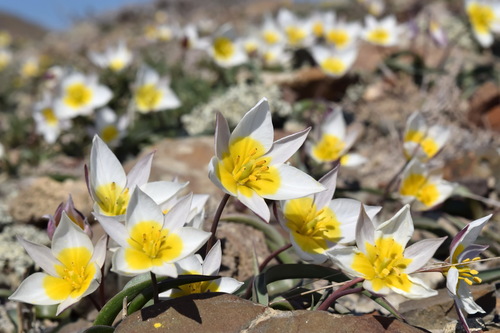
Tulipa biflora, commonly known as the two-flowered tulip, is a species of tulip. Its native range covers the former Yugoslavia, Crimea, Anatolia, the Caucasus, southern Russia, Egypt, the Middle East, Central Asia, Iran, Pakistan, Afghanistan, and Xinjiang, China. It has numerous published synonyms, one of which is Tulipa polychroma. This tulip grows on screes, rocky slopes, grassy slopes, and deserts, and is specifically found in the salt deserts of the Volga River basin. It is often found growing alongside the small yellow tulip, Tulipa sylvestris. When cultivated, a single stalk usually produces two flowers, though it occasionally bears one or three. Its stems can reach up to 10 cm in height. The plant typically produces two grey-green leaves, sometimes more, which are lanceolate, meaning they are shaped like a lance. It blooms from late winter to spring. Its flowers measure 2 to 3.5 cm long; they are white with a yellow center, and the tepals have greenish-grey outer surfaces. The flowers have a pleasant fragrance. If ingested, most parts of this plant are poisonous.