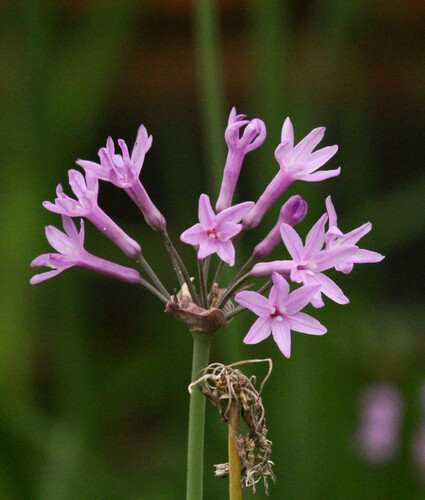
About Tulbaghia violacea Harv.
When grown as an ornamental plant, Tulbaghia violacea Harv. needs some protection from winter frosts. This species, along with its cultivars 'Purple Eye' and 'Silver Lace' (the latter having cream-margined leaves), has all received the Royal Horticultural Society's Award of Garden Merit. Research shows treating T. violacea seeds with a smoke solution increases the leaf mass and height of resulting seedlings. Exposing seeds to aerosol smoke also leads to a higher percentage of seedling survival. Some fatalities and specific symptoms including gastro-enteritis, abdominal pain, stopped gastro-intestinal peristalsis, sloughing of the intestinal mucosa, and pupil contraction have been linked to medications prepared with T. violacea. There has been speculation that this species may cause poisonings, but tests on rabbits found no negative effects. It is possible that reported adverse effects stem from extensive use and/or high dosages of the plant. Adverse effects are generally assumed to be associated with steroidal saponins and/or sulphur compounds found in the plant. In 2011, Ncube et al. found that the leaves and flowers of T. violacea are edible when used as vegetables. In 2003, Elgorashi et al. used the Ames and VITOTOX tests and determined that these leaves and flowers are non-toxic. T. violacea leaves are eaten as a substitute for chives and garlic. In South Africa, Zulu people consume the leaves and flowers as a leaf vegetable similar to spinach, or use them to season meat and potatoes. T. violacea is used locally as a herbal medicine to treat multiple ailments. As more evidence emerges of its potential as an antifungal agent, large-scale commercialization of the species is expected. This commercialization could threaten the entire Tulbaghia genus, however, because the genus is susceptible to overharvesting.