About Tulbaghia acutiloba Harv.
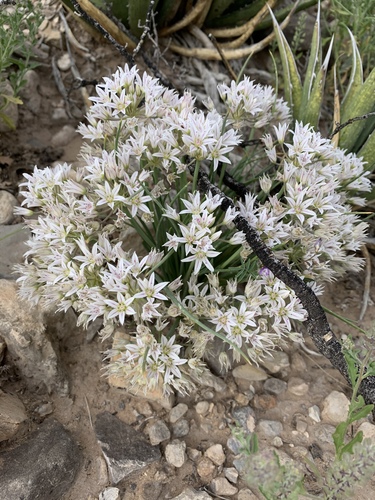
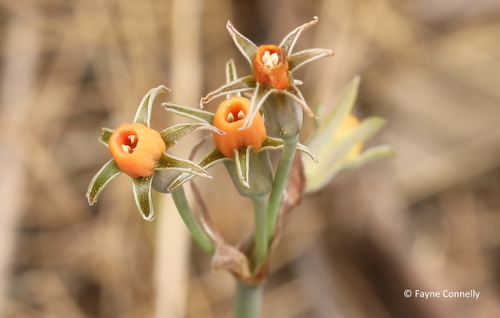
Tulbaghia acutiloba Harv. is one of 22 species in the genus Tulbaghia native to tropical and southern Africa. It is a clump-forming, bulbous perennial that grows 15 to 45 centimetres (5.9 to 17.7 in) tall. Its leaves are narrow and grass-like, measuring 50 to 450 millimetres (2.0 to 17.7 in) long and 3 to 8 millimetres (0.12 to 0.31 in) wide. The plant's rhizome can reach 3 centimetres (1.2 in) in diameter, and touching the plant releases a garlicky scent. Its small, trumpet-shaped flowers measure around 8 by 4 millimetres (0.31 in × 0.16 in), and display shades of green, white, and orange-brown. Khaki-colored flowers are set within green recurved tepals and a fleshy orange to reddish-brown ring, arranged in an umbel that holds 2 to 6 flowers. The flowers have a sweet scent that is especially noticeable in the evening. Tulbaghia acutiloba can flower throughout the year, with peak flowering from August to November (late winter to early summer in Southern Africa), and it may flower multiple times in a single growing season. This species is distributed across Botswana, Eswatini, Lesotho, and eastern South Africa. In South Africa, it occurs in the Eastern Cape, Free State, Gauteng, KwaZulu-Natal, Limpopo, Mpumalanga, and North West provinces. In Botswana, it is found only in the southeastern part of the country. Its preferred habitat is dry, rocky grassland at elevations up to 1,800 metres (5,900 ft).