About Tuberaria guttata (L.) Fourr.
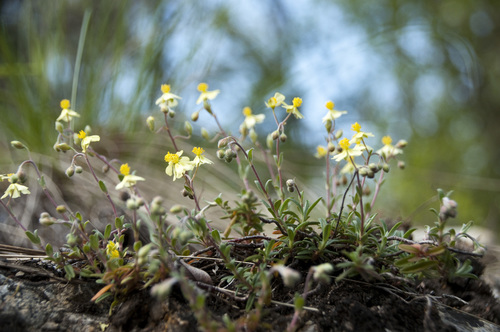
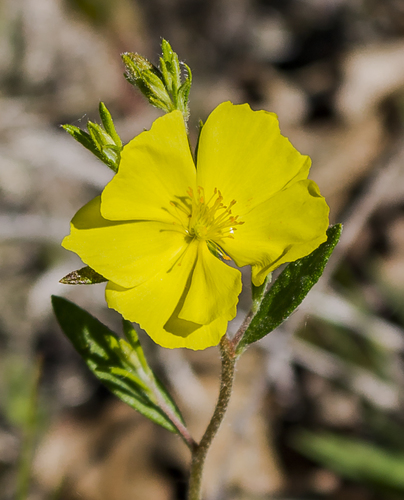
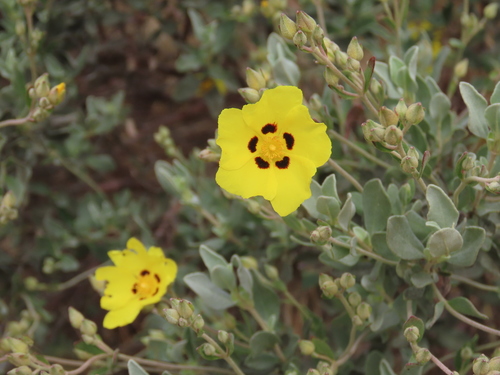
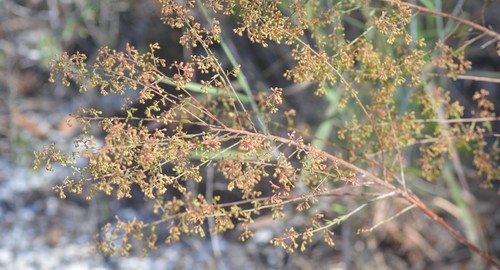
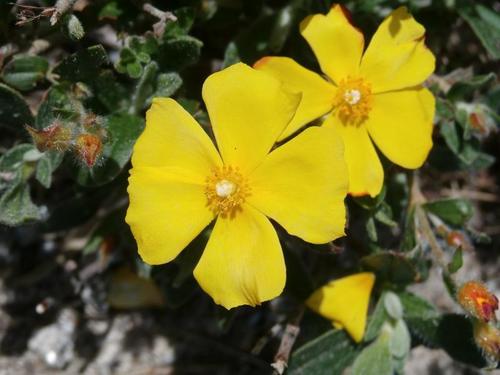
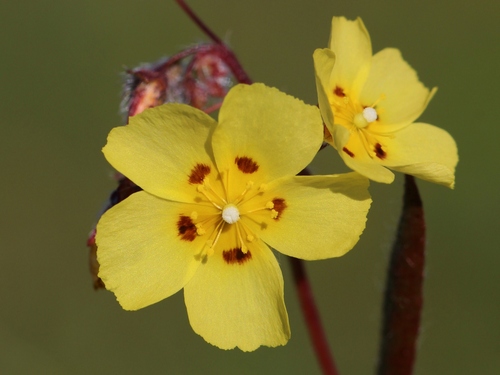
Tuberaria guttata (L.) Fourr. is an annual plant that reaches 2–30 centimetres (1–12 in) in height. It produces a rosette of basal leaves, each growing up to 3 cm (1.2 in) long and 1.5 cm (0.6 in) wide, but this rosette is normally completely withered by the time the plant blooms. Its stems bear 2–5 opposite pairs of leaves, with a few smaller alternately arranged leaves growing higher up the stem. The inflorescence holds around 12 flowers, each 8–12 mm (0.31–0.47 in) in diameter. Each flower has five uneven sepals and five yellow petals that usually bear a dark red spot near the base. The flowers are cleistogamous: they produce little pollen, no nectar, attract very few insect visitors, and their petals fall off just a few hours after opening. The center of each flower contains around 20 stamens and a single capitate stigma. The fruit of T. guttata is a capsule that holds many seeds, each 0.6 millimetres (0.024 in) long. Tuberaria guttata is widely distributed across the Mediterranean region, with a continuous distribution along the French Atlantic coast extending as far north as the Channel Islands. Further to the north, its distribution is very patchy, and the species is restricted to just a few localities on the west coasts of Ireland and Wales. The best-known of these northern populations grows on the slopes of Holyhead Mountain in Anglesey, and these British populations mark the northernmost limit of the species' natural range. In 2002, Plantlife selected Tuberaria guttata as the county flower of Anglesey. Tuberaria guttata has become naturalized in the foothills of the Sierra Nevada, on the eastern edge of the Sacramento Valley in California. In the Mediterranean region, T. guttata is common in arid habitats ranging from woodlands to grasslands and roadsides. In the British Isles, it grows in bare patches of thin, dry soil overlying hard igneous rock, in open areas within wind-cut heath near the sea.