About Tsuga canadensis (L.) Carrière
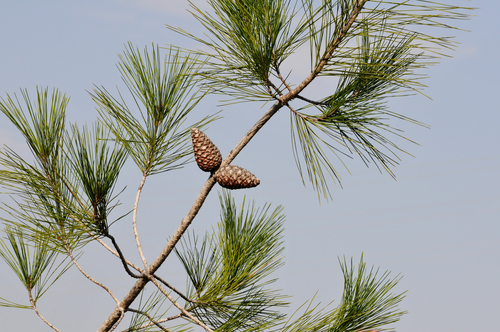
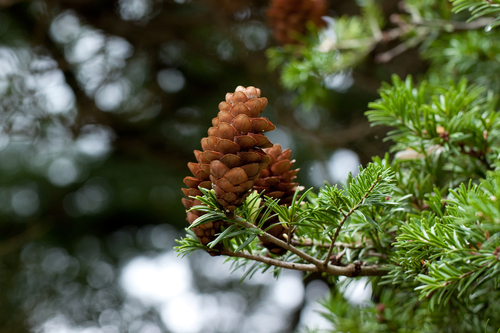
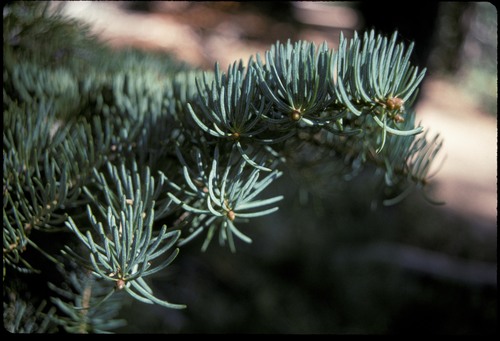
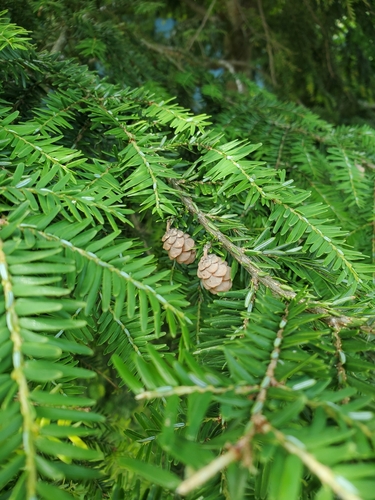
Tsuga canadensis (L.) Carrière, commonly called eastern hemlock, grows well in shade and is very long lived. The oldest recorded specimen, found in Tionesta, Pennsylvania, is at least 554 years old. Most trees reach around 31 m (102 ft) in height, though exceptional individuals can grow as tall as 53 m (174 ft). Trunk diameter at breast height is often 1.5 m (4 ft 11 in), and the largest recorded specimens reach 1.75 m (5 ft 9 in). The trunk is usually straight and monopodial, and only very rarely forked. It has a broadly conic crown. Its brownish bark is scaly and deeply fissured, especially as the tree ages. Twigs are yellow-brown with darker red-brown pulvini, and are densely pubescent. Buds are ovoid and very small, measuring just 1.5 to 2.5 mm (0 to 1⁄8 in) in length. They are usually non-resinous, but may be slightly resinous. Leaves are typically 15 to 20 mm (0.59 to 0.79 in) long, and can range from 5 mm (0.20 in) to 25 mm (1 in) in length. A unique characteristic of this species is that leaves are attached to small stalks, a feature not found in other evergreen trees. The leaves are flattened and typically distichous (two-ranked). The upper surface is shiny green to yellow-green, while the lower surface is glaucous with two broad, clearly visible stomatal bands. Leaf margins are very slightly toothed, especially near the apex. Seed cones are ovoid, typically 1.5 to 2.5 cm (5⁄8 to 1 in) long and 1.0 to 1.5 cm (3⁄8 to 5⁄8 in) wide. Cone scales range from ovate to cuneate, measuring 8 to 12 mm (3⁄8 to 1⁄2 in) long by 7.0 to 10 mm (1⁄4 to 3⁄8 in) wide. The cone scale apex is roughly rounded and often projects outward. Eastern hemlock has 24 diploid chromosomes in its DNA. In the northern part of its range, T. canadensis grows at sea level; across most of its range, it occurs primarily at elevations of 600–1,800 m (2,000–5,900 ft). Its range extends from northeastern Minnesota east through southern Quebec to Nova Scotia, and south along the Appalachian Mountains to northern Georgia and Alabama. Disjunct populations exist in the Piedmont region, northern Alabama, western Ohio, Indiana, western Wisconsin, and eastern Minnesota. In Canada, it is found in Ontario and all provinces east of Ontario, excluding Newfoundland and Labrador. Its entire range overlaps with the range of the closely related Tsuga caroliniana. It grows primarily on rocky ridges, ravines, and hillsides with relatively high moisture levels. It grows in association with many forest mushrooms, including Ramaria flavosaponaria and Ganoderma tsugae, commonly called hemlock varnish shelf. Tsuga canadensis has long been a popular cultivated tree. Its preference for partial shade and tolerance of full shade let it be planted in areas where other conifers do not grow easily. Its fine-textured foliage that droops to the ground, pyramidal growth habit, and ability to tolerate hard pruning make it a desirable ornamental tree. For cultivation, it prefers slightly acidic to neutral, nutrient-rich, moist but well-drained soil. It is most commonly used as a specimen tree, for screening, or in small group plantings, and can also be trained as a dense formal hedge. It should not be planted along roadsides where salt is used in winter, because its foliage is sensitive to salt spray. It is also poorly suited for use as a windbreak tree, as wind exposure causes winter dieback. It has several drawbacks: it has fairly low tolerance to urban stress, it cannot tolerate very wet or very dry soils, and it is susceptible to infestation by hemlock woolly adelgid, though adelgid infestations are treatable. It sheds needles rapidly after being cut, so it is not suitable for use as a Christmas tree. It was introduced to British gardens in 1736. In the United Kingdom, it is commonly found in both large and small gardens, as well as some parks, and is most common in the eastern parts of the country. It is sometimes used as a hedge, but it is considered inferior for this use compared to Tsuga heterophylla (western hemlock). It is not well adapted to the UK climate, so it often develops a poorly formed, forked, and sinuous trunk in the UK. In Germany, it is the most commonly cultivated hemlock, and is also used in forestry. American pioneers made tea from the tree's leafy twigs and used its branches as brooms. Tea can also be made from the needles. The inner bark, best harvested in winter through early spring, can be eaten raw or boiled, and can also be processed into flour.