About Trypoxylus dichotomus (Linnaeus, 1771)
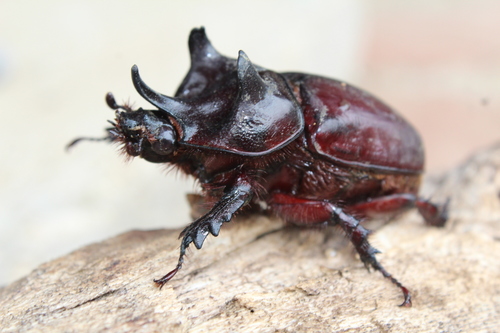
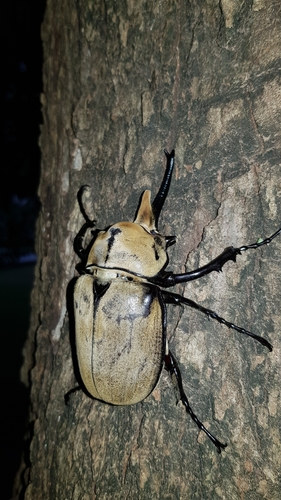
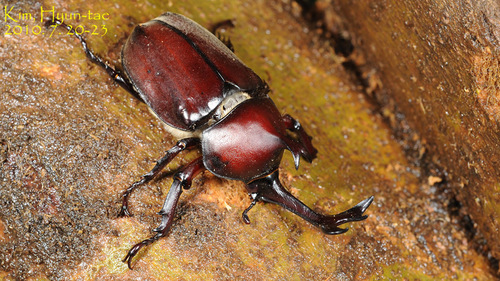
Trypoxylus dichotomus (Linnaeus, 1771), commonly called the Japanese rhinoceros beetle, typically has a dark brown and red body appearance, but this can look black when not exposed to direct light. On average, males grow to between 40 and 80 millimeters in length, while females are smaller, reaching between 35 and 60 millimeters. Males display a distinct sexually dimorphic horn that protrudes from the base of the head; this cephalic horn can grow up to one-third of the beetle's total body length, ranging from 7 to 32 millimeters, and is thin and pitchfork-shaped. Because the horn is a sexually dimorphic trait, only males grow one. The horn acts as a lever arm, and males use it to fight other males to gain access to territory and females. Despite the large size of their cephalic horn, male Japanese rhinoceros beetles can still fly, and both males and females fly at similar average speeds. Males with horns that are proportionally large relative to their body size have larger wings to compensate for this extra weight. Recorded elytra length for males ranges from 19 to 33 millimeters.
This species is widely distributed across Asia, and can be found in China, Japan, Taiwan, Vietnam, Myanmar, Laos, India, Thailand, and the Korean Peninsula. It prefers to live in broad-leaved forests with tropical or subtropical climates, and is also often found in mountainous environments. Across different populations and regions, male beetles vary greatly in size and horn performance, and this variation is thought to be caused by differences in the relative intensity of selection on these traits.
Female Japanese rhinoceros beetles scatter their eggs into the humus layer of soil between July and September. Larvae feed on humus, develop to the third instar phase, and pupate in June to July of the following year. Adult beetles emerge from the soil within a few months after pupation, and the full development from egg to adult takes one year.
Trypoxylus dichotomus has been a common ingredient in traditional Chinese medicine for almost 2000 years, and its use in this practice has inspired modern research to confirm its potential benefits. Compounds extracted from T. dichotomus larvae have been found to have anti-obesity effects and antibiotic properties, confirming that extracts of this species have potential health benefits. One study found that extract from T. dichotomus larvae can significantly reduce the expression of genes linked to fat creation, which suggests that the larvae could act as a potential food source to help counteract obesity. Another study discovered two antibacterial proteins in T. dichotomus larvae, named A. d. coleoptericin A and B (with "A. d." abbreviating this species). These two proteins show significant activity against methicillin resistant Staphylococcus aureus (MRSA), a bacterial strain that is notoriously difficult to treat with standard antibiotics.
T. dichotomus larvae naturally consume rotting wood and fruit, so researchers have hypothesized that these larvae are able to produce phytochemicals: natural bioactive compounds that provide resistance to bacterial and viral infections. Follow-up research investigating potential health benefits of the larvae found that T. dichotomus extract has moderate antioxidant properties, and compounds from larval extract can scavenge free oxygen radicals to prevent harmful oxidation in the body. Demand has increased for natural alternatives to synthetic substances that cause harm to humans, for uses including reducing biological toxicity and food deterioration; T. dichotomus larval extract has the potential to serve as one such natural alternative.
As a food resource, T. dichotomus larvae are edible and have high nutritional content. They are commonly eaten across East Asia. Despite the nutritional benefits of consuming these larvae, many people avoid eating them because of their distinctly unpalatable flavor. Indoles are the primary volatile compounds that cause this unfavorable flavor. Several studies have tested methods to improve the flavor profile of T. dichotomus larvae. One study found that processing larval powder with yeast fermentation reduces the presence of unpalatable indoles, and also increases volatiles that create traditional fruit-like flavors. Another study found that lactic acid fermentation with bacteria can also improve the larvae's flavor profile.