About Trypoxylon politum Say, 1837
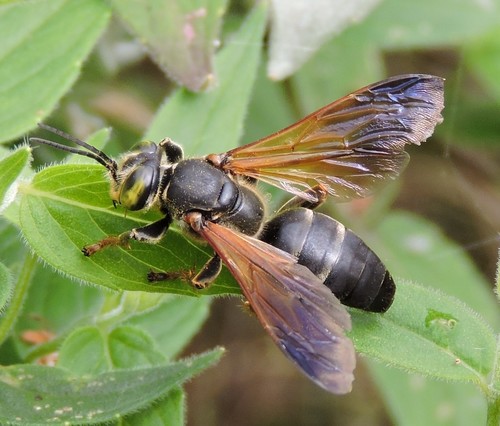
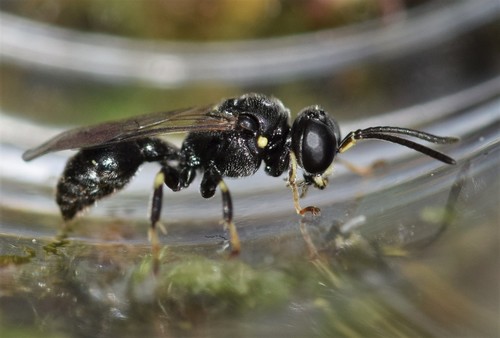
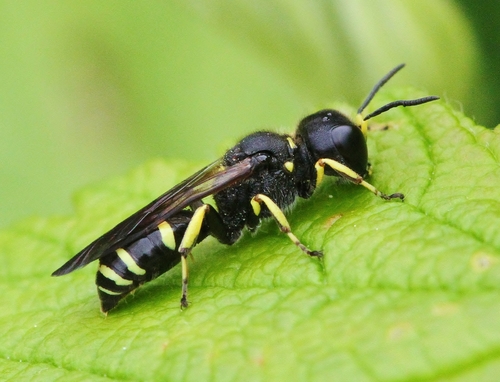
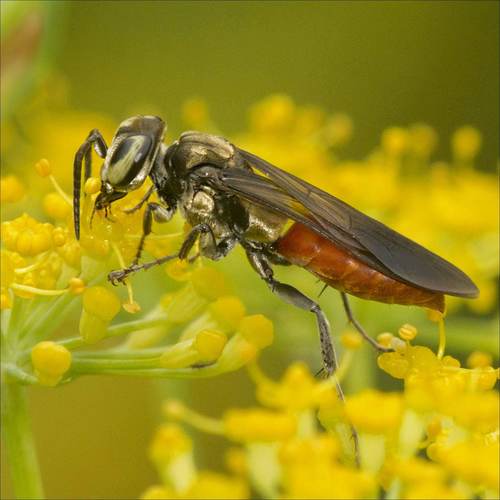
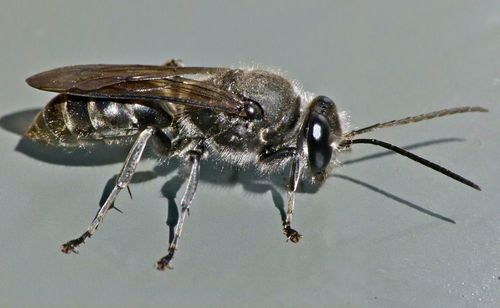
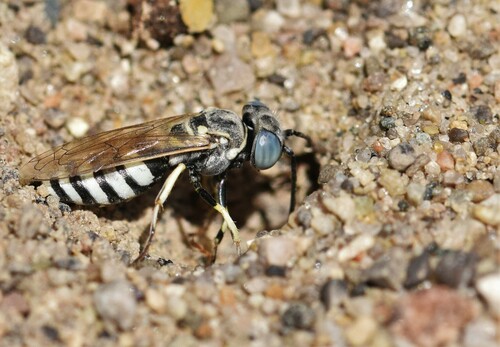
Trypoxylon politum Say, 1837, commonly known as the organ pipe mud dauber, is a predatory wasp that belongs to the family Crabronidae. This species is fairly large, with body lengths ranging from 3.9 to 5.1 cm. Adults have been recorded flying between May and September. Males and females have similar coloration: their bodies are shiny black, and the terminal segment of their hind leg is pale yellow to white. The species gets its common name from the distinctive shape and mud-based construction of its nests. It is native to eastern North America, with a distribution that extends from southeastern Canada to the eastern United States.
Organ pipe mud daubers are an exceedingly docile wasp species, and they are generally considered beneficial to have around because they control spider populations. Their larvae feed on living, paralyzed spiders caught by adult females. These wasps construct their mud nests inside tree holes or on the undersides of bridges. Females choose nest sites based on three key requirements: a smooth, vertical surface that provides ample shade and protection from rainfall, a nearby source of mud, and proximity to a forest.
Females build long mud tubes that contain multiple nest cells, and stock each cell with paralyzed spiders before laying a single egg inside the cell and abandoning the nest. When the eggs hatch, larvae feed on the stored spiders, then pupate until they develop into mature adults. A female can start her reproductive cycle in four different ways: she can build an entirely new nest, reuse an abandoned nest, challenge another female building a nest to claim it as her own, or very rarely enter a freshly constructed nest, remove the existing egg, and replace it with her own. Females typically build five or six mud tubes clustered together, arranged either side-by-side or stacked on top of one another. When tubes are added in stacked layers, the survival rate of newly hatched adult wasps drops. This is because newly emerged adults must chew their way out through the mud of their birth pipe to leave the nest, and more overlapping stacked layers make it harder for them to chew out successfully. The more pipes are clustered on top of each other, the lower the rate of newly developed wasps successfully emerging alive. A newly hatched adult female usually starts building her first new nest within 48 hours of leaving her birth nest.