About Tropaeolum tricolor Sw.
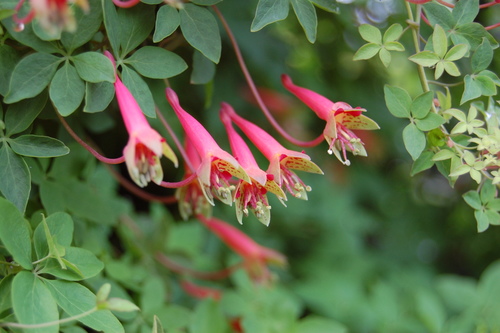
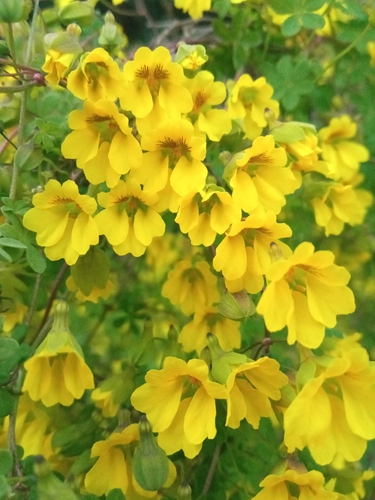
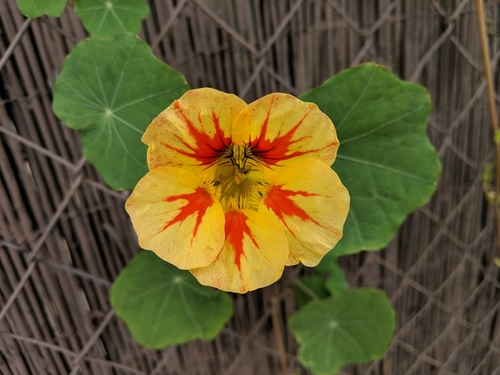
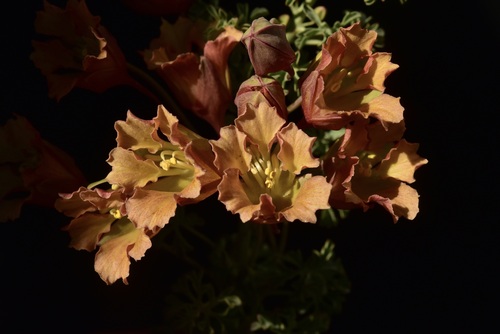
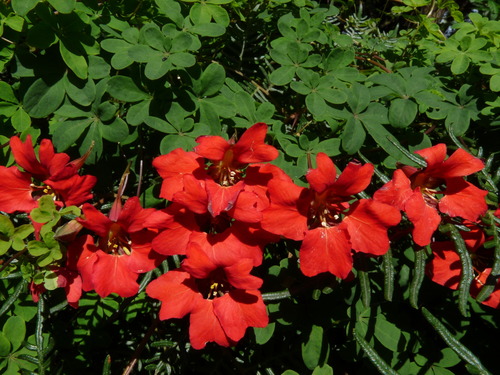
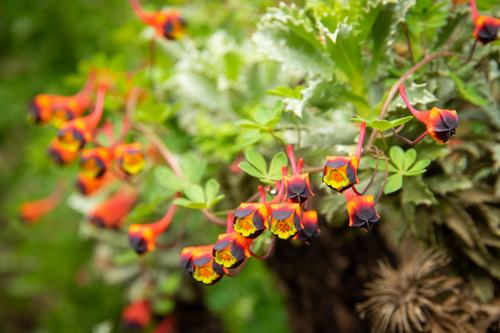
Tropaeolum tricolor, commonly called three-coloured Indian cress, is a summer-dormant climbing plant that flowers from winter through spring. It grows thin, straggly stems from a reddish root tuber, reaching lengths of 2 to 3 meters (6 ft 7 in to 9 ft 10 in). Its leaves are peltate, meaning the leaf stalk attaches at the center of the leaf blade; the leaves are nearly circular with five or six deeply cut lobes. Numerous flowers grow individually on long, wiry stalks that emerge from leaf axils. The flowers are narrowly funnel-shaped, around 3 centimeters (1.2 inches) long. The flower has five sepals that are red, orange, or yellow, tipped with a purple band, and extend backwards into a red spur. The small, rounded petals are greenish-yellow and have a clawed base. After the flower drops, the sepals turn brown and enclose the two or three dark brown seeds. In its native range, three-coloured Indian cress grows in cloud forests on the coastal mountains of northern Chile, at elevations between 300 and 900 meters (980 to 2,950 ft). Further south in Chile, it grows in inland temperate forests in the central and Los Lagos regions, at a range of elevations. In these southern areas, it grows on level ground or north-facing slopes, in conditions of full sun or dappled shade. It is adapted to survive summer droughts that last up to 10 months. Its tubers grow deeply buried in the ground, and are hardy to temperatures of approximately −8 °C (18 °F), and can tolerate short periods of snow cover. In cultivation, the Royal Botanic Gardens Kew in England grows three-coloured Indian cress in a frost-free Alpine house. Its tubers are replanted each September into large, well-drained pots filled with loam-based compost. The plant begins growth quickly after planting, forms flowers in spring, and remains in flower for several months. It can be propagated by seed or by dividing tubers; new tubers often form at the very bottom of cultivation pots, or force their way out through the pot's drainage holes. This plant is rated for USDA Hardiness Zone 8. When cultivated in the United Kingdom, it cannot tolerate freezing conditions, so it must be grown under glass in all locations except the mildest regions. Tropaeolum tricolor has received the Royal Horticultural Society's Award of Garden Merit.