About Tropaeolum majus L.
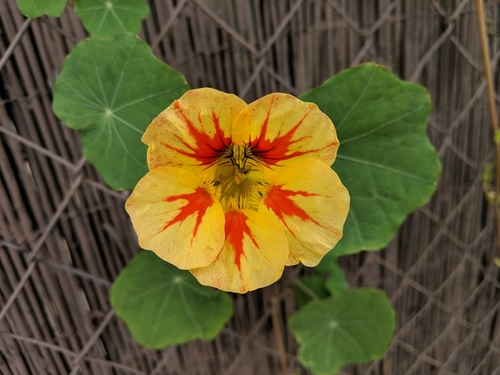
Tropaeolum majus L. is a fast-growing plant that can be either annual or perennial, with trailing stems that reach 0.9–1.8 m (3–6 ft) in length. Its leaves are large, nearly circular, 3 to 15 cm (1 to 6 in) in diameter. The upper surface of the leaf ranges from green to glaucous green, while the lower surface is paler. Leaves are peltate, with a 5–30-cm-long petiole attaching near the center of the leaf blade. Several veins radiate out to the leaf margin, which is smoothly rounded or slightly lobed.
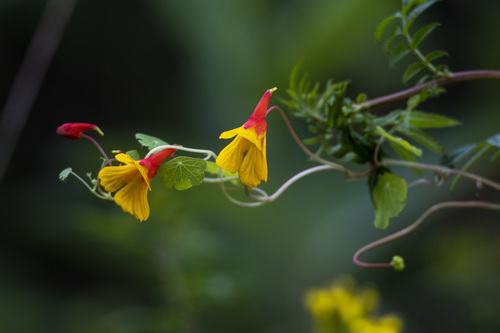
Flowers of this species are 2.5–6 cm in diameter, mildly scented, with five petals, eight stamens, and a 2.5–3-cm-long nectar spur at the back. Petal colors range from yellow to orange to red, petals are frilled, and they are often darker at their base. The fruit is 2 cm wide, with three segments; each segment holds a single large seed 1–1.5 cm long.
This species has a cultivated, likely hybrid origin. It originates from the Andes mountain range, from Bolivia north to Colombia. It has become naturalized in parts of the United States including California, New York, Pennsylvania, New Hampshire, Massachusetts, Connecticut and Virginia, as well as in parts of Europe, Asia, Africa and Australia. It is classified as invasive in Hawaii and Lord Howe Island, Australia.
Garden nasturtium acts as a food plant for the larvae of some lepidopteran species, including the dot moth, the garden carpet moth, and the large white, or cabbage white, butterfly.
Cultivars of Tropaeolum majus are widely grown as easy-to-grow annual plants. They will grow in poor, damp soil when placed in full sun. Their large seeds are easy to handle individually. Since they cannot tolerate heavy frost, they are best sown under glass with heat in cooler climates, and planted outdoors after all risk of frost has passed. Alternatively, because they grow quickly, they may be sown directly in their final growing location after the last frost passes. Many flower colors are available in the warm color spectrum, ranging from cream through yellow, orange, red and maroon. Some cultivars have highly decorative marbled patterning on their leaves. The Whirlybird Series and Alaska Series cultivar groups have received the Royal Horticultural Society's Award of Garden Merit.
All above-ground parts of Tropaeolum majus are edible. The flower is the most commonly consumed part, and it works as a particularly ornamental ingredient for salads. It has a slightly peppery flavor similar to watercress, and is also used in stir fries. Per 100 g (3+1⁄2 oz), flowers contain around 130 milligrams (0.0046 oz) of vitamin C, roughly the same amount found in parsley. They also contain up to 45 milligrams (0.0016 oz) of lutein per 100 grams (3.5 oz). Unripe seed pods can be harvested and placed in spiced vinegar to make a condiment and garnish, and are sometimes used as a replacement for capers. Some native South American peoples used this plant for medicinal purposes, apparently for its antibiotic, including antibacterial, properties. Some Europeans have consumed it to treat urinary and genital infections.