About Tropaeolum incisum (Speg.) Sparre
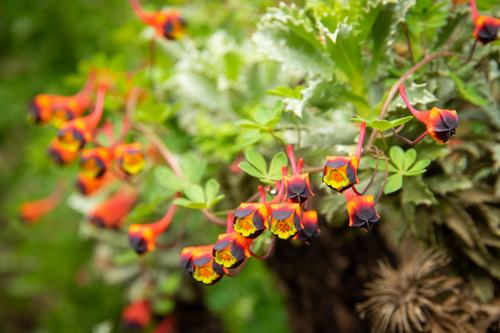
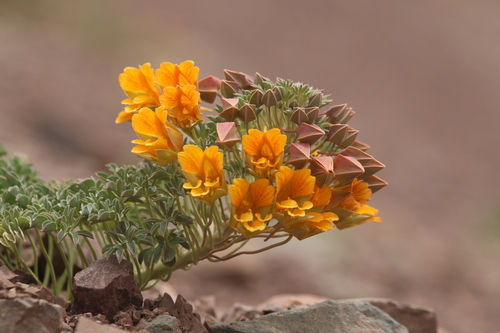
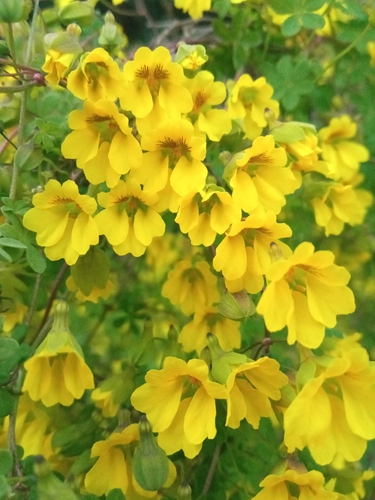
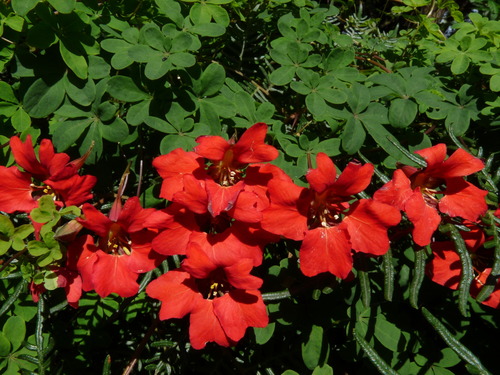
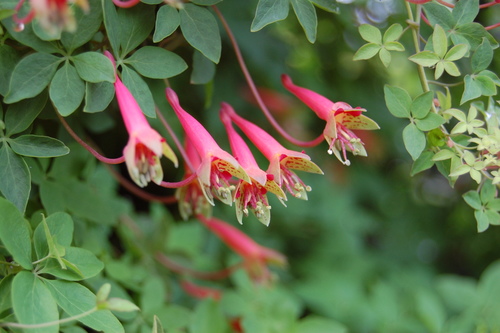
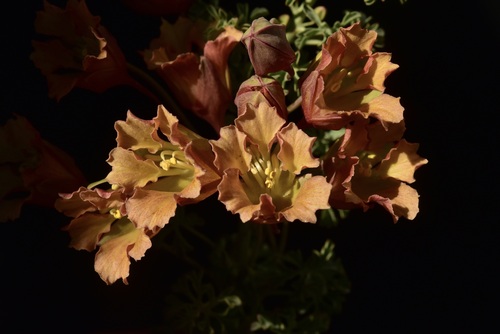
Tropaeolum incisum (Speg.) Sparre is a hairless perennial herbaceous plant with a deep underground tuber. Its stem is typically unbranched, usually procumbent and sometimes climbing, generally reaching up to around 60 cm long and 4 mm in diameter. When grown in good garden soil, plants grow more vigorously and can climb up to 2 m. Its leaves are alternate, lack stipules, and have 2–5 cm long leaf stalks. Leaf blades are roughly circular, measuring 1.5–3.5 cm across, and are palmately divided into five to nine, most often seven, blue-grey leaflets. Young leaflets particularly have thin purplish edges. Each leaflet is deeply pinnately incised into two to seven lanceolate lobes, which may bear additional teeth. The lobes have a blunt tip that sometimes ends abruptly in a sharp point, and are folded in a V-shape along their midveins. Flowers are bisexual and zygomorphic, borne on 4–10 cm long stalks. The calyx is made up of five sepals that are yellowish, apricot, or blue-grey, and sometimes tinged purple. It has five equal-sized triangular lobes that measure 8–13 by 4–8 mm, and a slender 12–20 mm long spur with a narrow base. Petals are dull yellow, pinkish yellow, orange-yellow, or dark yellow with purple veins, and have more or less red-purplish staining on the back of their lobes. Each petal has a claw and a lamina (blade). The upper two petals have an almost elliptical lamina with a blunt tip and wavy margins, measuring 12–17 by 5–12 mm. The lower three petals have longer claws, indented tips, and measure 10–17 by 3–10 mm. Like all Tropaeolum species, this plant has eight stamens. Its pollen is roughly 17.5 by 13 μm, radially symmetric, rounded triangular, tricolpate, oblate (flattened), with short furrows around 4 μm long. It has a superior three-carpelled ovary; when ripe, this splits into three blackish, one-seeded 5–6 mm long mericarps. In its native range, it flowers from September to February. This species is concentrated in the Argentinean lake district of northern Patagonia, across northern Chubut, western Río Negro, Neuquén, and southern Mendoza Provinces. It also occurs in neighboring Chile, but only near the mountain passes. It can grow at elevations up to 3000 m, in arid sandy fields and low scree located in the rain shadow of the Andes. Hyposchila galactodice, a pierid butterfly found in western Patagonia, Argentina, is a specialist that feeds on Tropaeolum incisum. Tropaeolum incisum is sometimes cultivated as an ornamental plant, and is sold by several seed companies and nurseries. It grows best in free-draining soil in full sunlight, kept free of plant competition. It is often grown in locations such as bulb frames or alpine houses, especially in climates that are moist during the plant’s hibernation period.