About Trochocarpa thymifolia (R.Br.) Spreng.
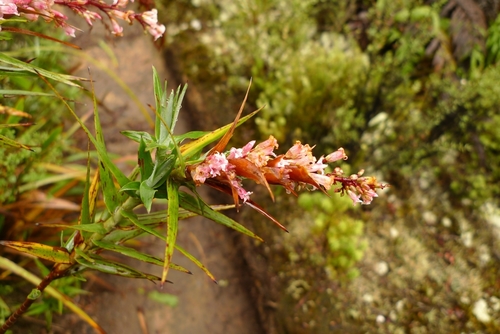
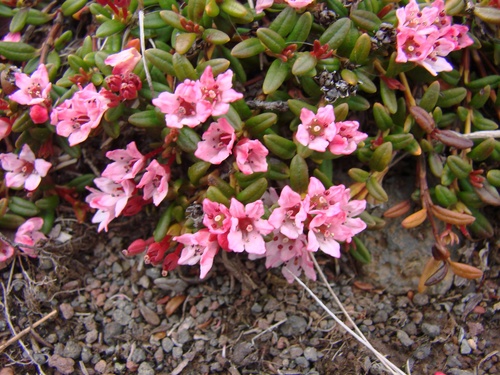
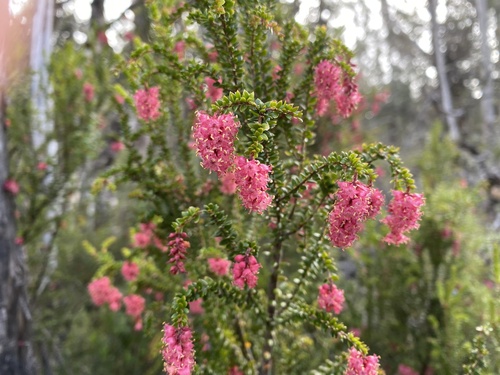
Mature Trochocarpa thymifolia are erect, bushy shrubs that reach approximately 1 meter in height. Their leaves are small, measuring 2–4 mm long, arranged alternately, densely packed, and shaped from ovate to elliptic. These succulent leaves are dark green with a red tinge along their margins, and are a slightly lighter green on the underside. Clear parallel venation on the abaxial (lower) leaf surface is a distinguishing characteristic of the Ericaceae family, which this species belongs to. The flowers are tubular, pink to red in color, have 5 lobes, and reach about 4 mm in length. They form dense clusters of drooping terminal inflorescence spikes that are 1.5 cm long; the prominent yellow filaments of the stamens sit just outside the floral tube. Fruits are spherical, fleshy, blue to purple or mauve, and measure approximately 8 mm in diameter. Flowers and fruits typically develop at the same time, creating striking contrasting color and texture displays alongside the species' neat foliage. Trochocarpa thymifolia is widespread across Tasmania. It most commonly grows in alpine heaths, open subalpine forests, and woodlands, and occasionally grows on more exposed sites among dolerite boulders. This species favors well-drained, moist environments with acidic soils. It is widespread across the state, clustering in alpine zones above the tree line. Its altitude range varies across Tasmania, from 750 m in the southwest to 1400 m in the northeast. Most populations are located within southern Tasmanian national parks: Mount Field, Mount Wellington (Kunanyi), Tasman National Park, and Southwest National Park. In northern Tasmania, populations are found in Cradle Mountain-Lake St Clair, Walls of Jerusalem, and Ben Lomond National Parks.