About Trochocarpa laurina (Rudge) R.Br.
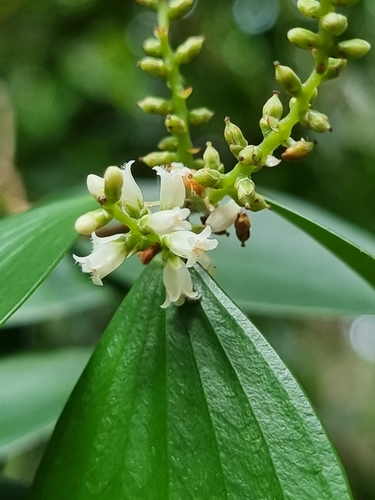
Trochocarpa laurina grows as a compact shrub or a crooked tree, reaching a typical maximum height of 13 m (43 ft), and has grey to brownish black bark. Its leaves are arranged alternately or in pseudowhorls at the ends of branches; they are elliptic to broadly elliptic, 50–70 mm (2.0–2.8 in) long and 20–30 mm (0.79–1.18 in) wide, borne on a 3–6 mm (0.12–0.24 in) long petiole, and are pink when young. The leaves have 5 to 7 roughly longitudinal veins, and their lower surface is a paler green than the upper surface. Flowers are borne singly or in 20–40 mm (0.79–1.57 in) long spikes at the ends of branches. The flowers are white, with bracteoles around 0.4 mm (0.016 in) long and sepals around 1 mm (0.039 in) long. The petals are joined at the base to form a tube 2–3 mm (0.079–0.118 in) long, with a bearded throat and erect, bearded lobes. Flowering occurs from December to January, and the fruit is a purple to black drupe. This species, also called tree heath, grows in gullies, among rocks, on creekbanks and on escarpments. It occurs in warm-temperate, subtropical, and sometimes dry rainforest on the coast and nearby ranges of New South Wales and Queensland. In August 1990, the largest known individual at that time was recorded in Eastwood, a suburb of Sydney; this specimen was 13.4 m (44 ft) tall. The fruit of Trochocarpa laurina is dispersed by mammals, birds, and flowing water, but germination is slow and can take up to 2 years. Plants of this species can resprout after fire. The fruit is eaten by Lewin's honeyeater and the pied currawong. Trochocarpa laurina is a host for the parasitic mistletoe Korthasella rubra, also known as korthal mistletoe. It also acts as a host tree for epiphytes including the bird's-nest fern and the elk horn fern. Aboriginal Australians used this species to make waddies.