About Trithrinax campestris (Burmeist.) Drude & Griseb.
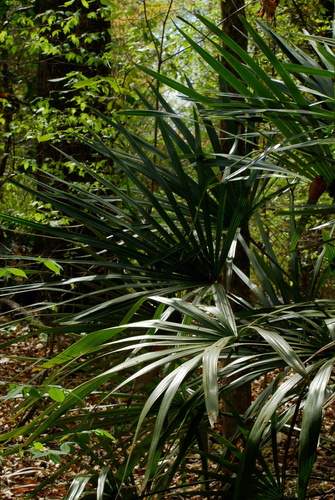
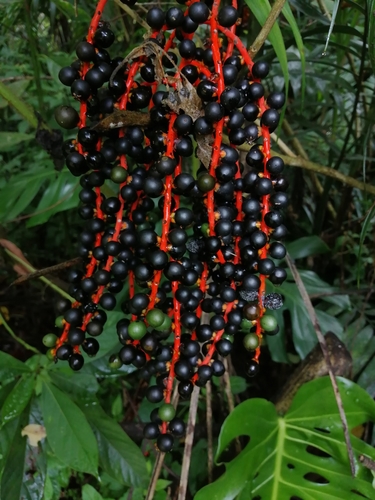
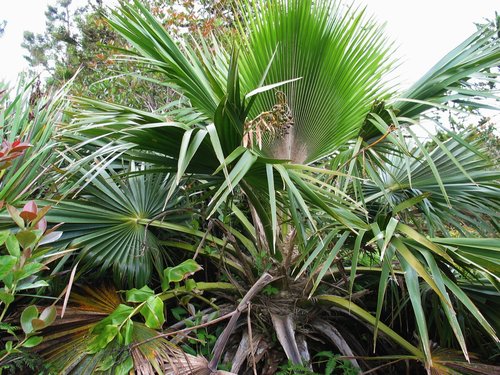
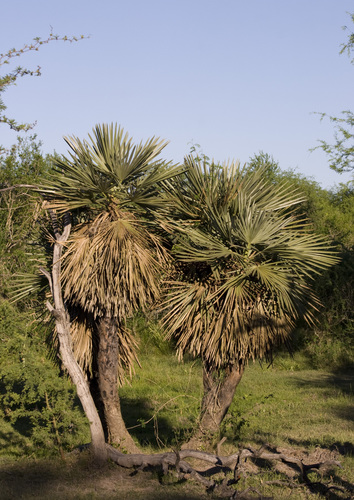
This species, Trithrinax campestris (Burmeist.) Drude & Griseb., is a short-statured monocot flowering palm. It reaches a maximum height of 6 m, with stems 20 to 25 cm wide that are usually covered by the fibrous-spiny remains of older foliage, forming a thick protective coat. Commonly called caranday, this palm produces palmate, rounded leaves roughly 1 m long, borne on very rigid, spiny petioles. Its leaflet segments are rigid, ranging in color from dark green to blue-green, with light green undersides. Its leaves are possibly the toughest of any species in the palm family Arecaceae. For mountain-growing caranday specimens, foliage becomes more grayish as habitat altitude increases. Flowers are arranged in highly branched inflorescences that grow at the base of the lowest living leaves. Each inflorescence holds up to 100 white hermaphrodite flowers, each 10 to 12 mm wide. This species flowers in autumn, and its fruits ripen at the end of the following summer. Fruits are subspherical yellow-brown drupes 1 to 2 cm wide, with a thin fleshy mesocarp and a fibrous endocarp. Caranday is monoecious, a trait common in conifers but rare among angiosperms. Trithrinax campestris prefers well-drained sandy or rocky soils, though it can tolerate extended persistent flooding. It is extremely resistant to drought, and can survive dormant-season temperatures between -9 °C and -15 °C, though it tends to shed its leaves under these cold conditions. It is counted among the most cold-hardy palms in the world, growing naturally in the mountains of Sierras de Córdoba and Sierras de San Luis, where high-elevation specimens tolerate unique cold conditions. It has successfully grown as far north as the British Isles. Its seeds germinate quickly, but subsequent growth is mostly slow. In its native range, this palm occurs naturally in small groups of multiple individuals, or forms large, densely dominant caranday forests. Its main environmental threats are deforestation and natural fire, since the thick dry stem coat of caranday is highly flammable.