About Trithemis annulata (Palisot de Beauvois, 1807)
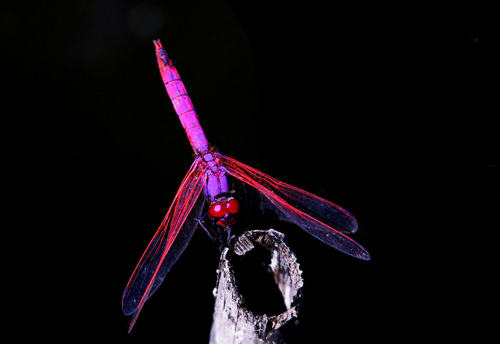
Trithemis annulata is a robust, medium-sized dragonfly with a wingspan of 60 mm (2.4 in). Mature males have a dark red head, a yellow labium with a brown central spot, red eyes with white spots along the rear edge, and a dark metallic purplish-red frons. Their prothorax is violet with slightly darker longitudinal stripes. Their membranous wings have distinctive red veins, an orange-brown pterostigma, and a large orange-brown patch at the base of the hindwings. The abdomen is fairly broad and pinkish-violet, with purple markings on the top of each segment and blackish markings on the final three segments. Females are a similar size to males, but have a brownish thorax and a yellow abdomen with dark brown markings. Female wings do not have the male’s red veins, but share the similar orange-brown wing patches. This species is very similar in appearance to the closely related red-veined dropwing (Trithemis arteriosa), which differs by having a more slender abdomen and a wedge-shaped black area on each side of the abdomen’s tip. Trithemis annulata is found across most of Africa, and also occurs in France, Cyprus, Greece, India, Iran, Iraq, Israel, Italy, Jordan, Kuwait, Lebanon, Mauritius, Oman, Portugal, Qatar, Réunion, Syria, Turkey, the United Arab Emirates, and Yemen. It was first recorded on the Maltese islands in 2005, and confirmed to be breeding there in 2007. Due to global warming, Trithemis annulata is expanding its range northward in Europe: in the late 1990s it advanced from southern Spain and southern Italy into France, and from Greece and Turkey into Central Europe. It has become established on the floodplain of the River Ebro in northeastern Spain, among other areas. Trithemis annulata is an adaptable species. Adult dragonflies tolerate a range of habitats, including semi-arid rangeland, and are commonly found flying near sluggish rivers, in marshes, and beside still-water ponds. They sometimes occur in brackish water habitats, though it is not known if they breed in salty water. Larvae develop rapidly, allowing this species to use temporary water bodies as breeding sites. Males are often seen perching on twigs of waterside shrubs and on rocks in full sunshine; in the evening or when the sun is obscured, they move into trees. Females are thought to deposit eggs by flying over the water surface and dipping the tip of their abdomen into the water. Larvae develop in water, where they are aggressive predators. Adult dragonflies are also predators, using their excellent eyesight to detect prey and their legs to hold and carry captured prey.