About Triteleia ixioides (Dryand. ex W.T.Aiton) Greene
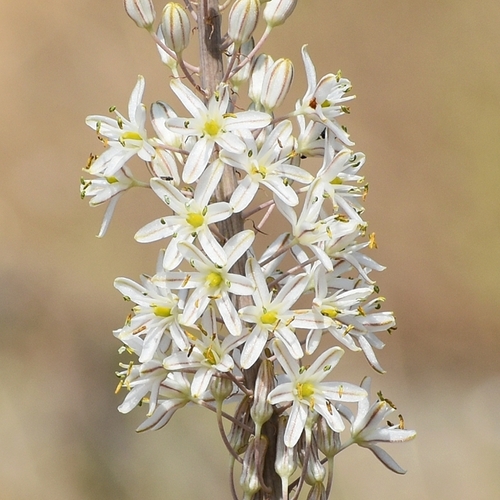
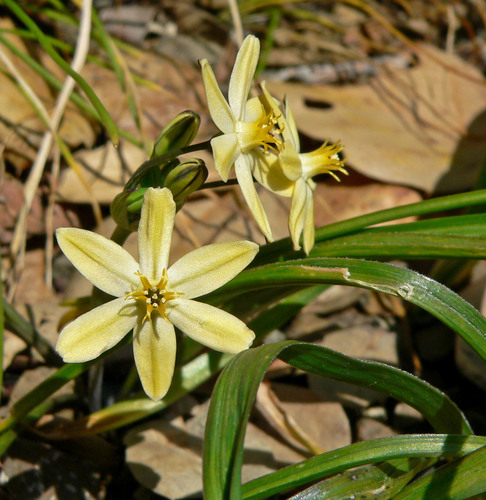
Triteleia ixioides (Dryand. ex W.T.Aiton) Greene is a perennial, herbaceous, monocotyledon plant that grows from an underground corm. It produces one or two grass-like, linear leaves, measuring 10–50 cm (4–20 in) long by 3–15 mm (0.1–0.6 in) wide, which emerge from the top of the corm in early spring. Similar to onion leaves, they have a longitudinal ridge called a keel on their underside, a channel on their upper side, straight margins, and a smooth surface. In mature plants, leaves are followed by a stiff, cylindrical flower stalk called a scape. The scape grows 10–80 cm (4–30 in) tall and 1–5 mm (0.04–0.2 in) in diameter; it is mostly smooth, but sometimes has a rough, scabrous texture at its base. Several thin green bracts enclose the developing buds at the top of the scape; as the flowers emerge, these bract membranes peel back and shrivel. The flowers grow in an umbel, the same arrangement seen in onion flowers, and each flower sits on a slightly upcurved stalk called a pedicel that is 1–9 cm (0.4–4 in) long, up to 12 cm (5 in) in subspecies cookii, and connects to the top of the scape. As with all Triteleia species, each flower has six tepals arranged in two whorls: three in an outer whorl and three in an inner whorl. The tepals are fused into a perianth tube at their base, then separate into distinct lobes surrounding the flower’s opening. The flowers of Triteleia ixioides range in color from straw-colored to golden yellow, and very occasionally they are white flushed with purple; the color of the upper and lower tepal surfaces are similar. Each lobe has a single distinct midvein, which is most often brown or purple, and occasionally green. The entire flower measures 12–27 mm (0.5–1 in) long. The perianth tube is relatively short at 3–10 mm (0.1–0.4 in), and has an acute base. A similar, less common species called Triteleia dudleyi, which grows at high elevations in the Sierra Nevada, has a much longer perianth tube with a rounded base. The six free tepal lobes of Triteleia ixioides are 6–20 mm (0.2–0.8 in) long; they generally grow perpendicular to the tube, but may range from ascending to reflexed. Inside the flower, the stamen filaments are the main identifying feature that separates Triteleia ixioides from related species, and also distinguishes between its five described subspecies. Each stamen attaches to its corresponding tepal at the same height, but filaments alternate in length: short filaments attach to the outer whorl of tepals, and long filaments attach to the inner whorl. The filaments are broad (dilated) and flattened, and each has a pair of forked apical appendages that extend above the point where the anther attaches. The appendages on the three longer filaments are pointed and easy to see. The anthers are 1–2 mm (0.04–0.08 in) long, and may be colored white, cream, yellow, or blue. Anther color was once used to identify some subspecies, but is no longer considered a reliable identifying trait. The ovary of Triteleia ixioides is longer than the stipe that supports it. After fertilization, flowers develop into ovoid, capsular fruits that are loculicidally dehiscent, meaning they split vertically down the center of each of their three chambers when ripe. The seeds are black, somewhat spherical, and have a ridge along one side. The seed surface has relatively large, irregularly distributed pits, and at a finer scale it is granulate or granulate–reticulate, meaning it is bumpy with partial net-like texture. The seed coat has a crusty texture. Triteleia ixioides has widespread polyploidy, with reported chromosome numbers 2n = 10, 14, 16, 24, 32, 40, 42, 50. Triteleia ixioides grows mostly in California, in an arc from the Transverse Ranges north through the Sierra Nevada, into the southern Cascade Range and the southeast slopes of the Klamath Range.