About Tripsacum dactyloides (L.) L.
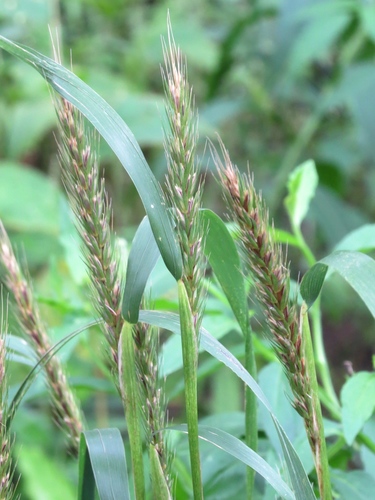
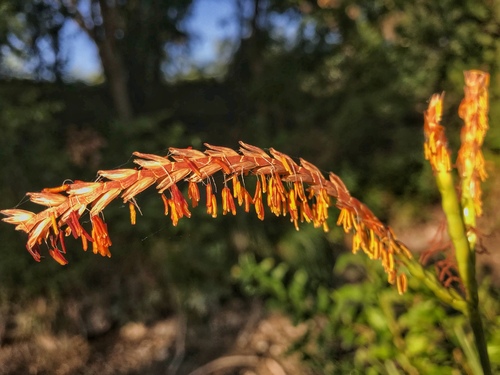
Tripsacum dactyloides (L.) L., commonly called gamagrass or eastern gamagrass, is a species in the grass family Poaceae, tribe Andropogoneae, and subtribe Tripsacinae — the same subtribe that includes Zea mays (corn). Gamagrass typically grows 2–3 feet (0.61–0.91 m) tall, but can reach heights of 8–10 ft (2.4–3.0 m). It produces several short, fibrous, thick rhizomes. Its rigid, thick rhizomatous roots anchor the plant firmly upright, allowing it to survive extended droughts and floods. Deep, hollow roots branch out from the plant’s lower nodes. Because gamagrass has short internodes, all of its leaves grow from the base of the plant. Clumps can reach up to 4 ft (1.2 m) in diameter. Stems and leaves are glabrous (hairless) and purplish in color. The glabrous leaf blade is around 1.5 m (4 ft 11 in) long and 9–35 millimetres (0.35–1.38 in) wide, with hairs at the base. Leaves have a distinct midrib, and can grow 12–24 inches (300–610 mm) long and 0.375–0.75 in (9.5–19.1 mm) wide. Eastern gamagrass blooms from late March to early October. Its flowers are arranged in spikes that contain both female and male spikelets; the species is monoecious, meaning it produces separate female and male flowers on a single individual. The inflorescence grows from a terminal axillary bud and is 10–30 centimetres (3.9–11.8 in) long. Inflorescences are usually a single raceme, or a panicle made of two to three unisexual single racemes. Seed production occurs from June to September. Seeds mature unevenly, and seed production is generally slow. As the fruit matures, the seedhead joints split in two, and each seed-bearing segment holds one seed. Seedheads range from 6 to 10 inches in size. Spikelets hold the grain and fruit to support reproduction, and mature female spikelets separate like pop-beads when they break down. Tripsacum dactyloides is widely distributed across the United States, ranging from Connecticut to Nebraska and south to Florida and Texas. It also occurs as far south as South America, in Paraguay and Brazil. It has been cultivated outside its native range in the southwestern United States and other areas. Ecologically, Tripsacum dactyloides is a larval host for Cymaenes tripunctus and Lerema accius. Its foliage is a food source for the larvae of Anisostena bicolor, Anisostena kansana, Sphenophorus maidis, and Chilophaga tripsaci. Bison, elk, and other large herbivores graze on its foliage. Small mammals, birds, and lizards use Tripsacum dactyloides for cover, and deer eat its fruit. Eastern gamagrass grows best on wet land such as river floodplains. It also maintains good growth on moist, nonalkaline lowland areas, which can tolerate longer periods of flooding. The most suitable soil for eastern gamagrass is moist, poorly drained fertile soil, in areas with annual precipitation of 900–1,500 mm (35–59 in) and a soil pH of 5.5 to 7.5. It can tolerate up to three weeks of flooding without dying. Its deep roots, which extend roughly 4.5 m (15 ft) underground, are the key adaptation that lets gamagrass tolerate drought. Early settlers in the United States widely considered eastern gamagrass a high-quality feedcrop. However, it declined due to the expansion of grain crops and cattle grazing. Starting in the late 1980s and early 1990s, eastern gamagrass regained attention as a summer forage, because it is productive, palatable, and easily digested by almost all cattle. For these reasons, gamagrass is ideal for use as a feedcrop, including as hay and pasture forage in systems with controlled grazing rotation. It is valuable for forage because its growing season starts earlier than other warm-season grasses and ends later than cool-season grasses and legumes. Eastern gamagrass requires a moderate amount of carbohydrates stored in its leaf bases for regrowth. If grazed before carbohydrates accumulate in the leaf bases, the plant will die from overgrazing. Gamagrass also works well as a wildlife habitat. Gaps between scattered clumps and the tented canopy formed by leaves growing from rhizomes and drooping toward the center make the plant an attractive habitat for wildlife. For example, the open space in the center of clumps is large enough for wild birds such as quails and prairie chickens to build nests. It also provides good winter cover for grassland sparrows. Gamagrass grows from mid-April to mid-September, which is slightly earlier in the year than other native warm-season grasses like big bluestem (Andropogon gerardi) and switch grass (Panicum virgatum). Its high relative yield in summer is the main reason it makes a good feedcrop when cool-season grasses such as tall fescue are not yet grown.