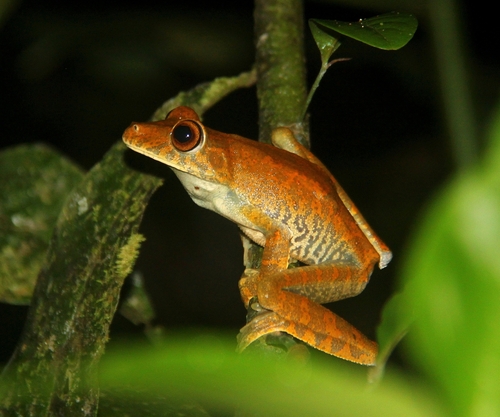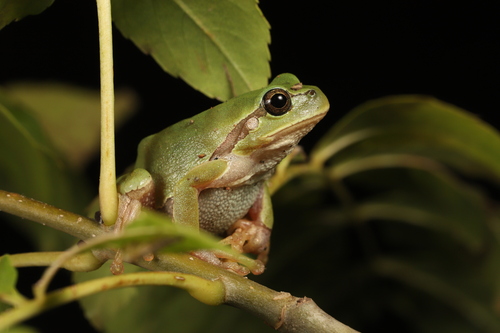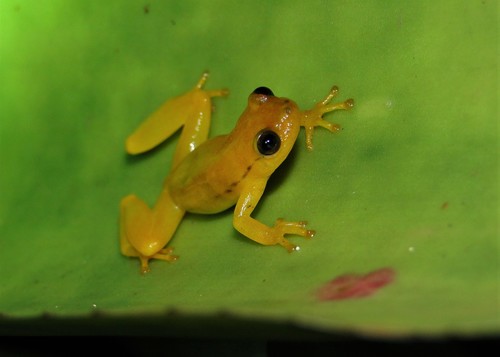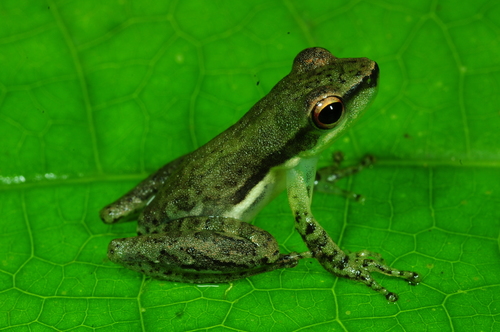
About Triprion spinosus (Steindachner, 1864)
Size
Triprion spinosus is a relatively large frog, with a snout-to-vent length ranging from 5.8 to 8 cm (2.3–3.1 in).
Dorsal Projections
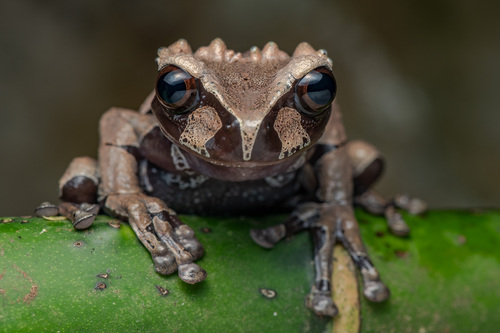
It has many sharp, pointed projections across its head and dorsal surface, a trait that gives the species its common name.
Head Morphology
The skin on its head is fused to the skull, and its tympanum is very large.
Limb Structure
Its legs are long and slender, and each digit has an adhesive disc at the tip.
Coloration
The species' dorsal surface is pale brown or gray with dark markings, while its flanks are dark brown or black, with these two color groups separated by a narrow white band.
Native Habitat Range
Triprion spinosus lives in lowland rainforests and montane humid forests at elevations between 95 and 2,000 m (310–6,560 ft) above sea level.
Modified Habitat Tolerance
However, in at least Costa Rica and Panama, it can also be common in young secondary growth forests and coffee plantations located far from undisturbed primary forest.
Breeding Site Type
Breeding for this species occurs in tree holes.
Threats
It is threatened by severe disturbance, clearance, and conversion of its original native habitat into open areas.
Conservation Measures
The species occurs in a number of existing protected areas, and a captive "insurance population" is bred and maintained by Panama's El Valle Amphibian Conservation Center, the Atlanta Botanical Garden in the United States, and a small number of AZA-accredited zoos.
Activity and Male Call
This species is active at night, and the male's characteristic "boop...boop...boop" call is more often heard than the frog itself is seen.
Calling and Oviposition Sites
Males call from the edge of temporary water bodies, which may be water-filled hollows in trees or water caught in the rosette of a bromeliad; this is also where females lay their eggs.
Tadpole Habitat Tradeoffs
Developing tadpoles in these small sites are protected from large predators like fish, but these tiny pools do not provide enough suitable food for the growing tadpoles.
Tadpole Feeding Behavior
The female solves this lack of food by periodically visiting each of her egg-laying sites to lay unfertilized eggs that the young tadpoles can eat.
Feeding Trigger
Tadpoles trigger this behavior by nibbling on the female's belly.
Tadpole Group Size
Up to sixteen tadpoles have been recorded in a single small transient pool.