About Tripleurospermum inodorum (L.) Sch.-Bip
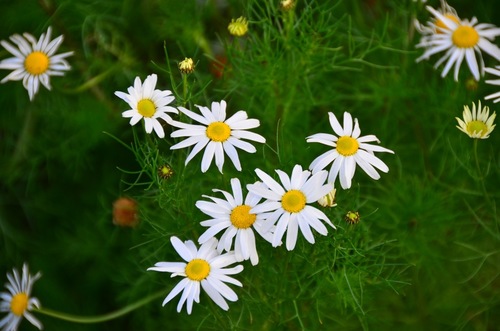
Tripleurospermum inodorum (L.) Sch.-Bip typically reaches a height of 20–80 cm (7.9–31.5 in). It usually grows one stem per plant; the stem is erect to ascending, branched, glabrous (hairless), and green. The single erect stem branches in the upper portion of the plant, is weakly ridged or lined, and is hairless at maturity, though it may be sparsely hairy when young. Leaves grow in an alternate arrangement, and are either short-stalked or stalkless. The leaf blade is 2–3 times pinnately lobed (or divided into leaflets), is glabrous, and has long, thread-like narrow, sharp-pointed lobes or leaflets. Whole leaves measure ¾ to 3 inches long, and have a feathery texture with a few to numerous thread-like branching lobes. The species' cotyledons are orbicular to oblong, very small at 3 to 5 mm long, and stalkless. Its flower heads (capitula) are single and flower-like, usually 3–5 cm (1.2–2.0 in) across, and surrounded by involucral bracts. The ray florets on the edge of the capitulum are white, tongue-shaped, with a shallowly 3-toothed tip. The inner disc florets are yellow, small, and tubular. This species has 5 stamens, and a pistil formed from 2 fused carpels. The involucral bracts vary in length, are 1–1.5 mm (0.039–0.059 in) broad, and have light brown to white margins. The central disc of the capitulum is thickly stacked and full. 1 to 20 capitula are borne in a corymbose cluster. Flowering occurs from June to October. Solitary bees collect pollen from this species. The fruit is a flattish, ridged achene, with 2 round to angular oil spots, and its tip sometimes bears a small, membranous ring. Ecologically, T. inodorum grows in fields, fallow land, lawns, wasteland, roadsides, yards, and gardens. It is an annual or short-lived perennial, and is native to Eurasia. In the U.S. state of Washington, it is classified as a Class C noxious weed, and it is considered invasive in other U.S. states, and is resistant to some herbicides. It is a weed of cereal crops in western Canada. Under Canadian regulations of the 2016 Canadian Weed Seeds Order (within the Seeds Act), it is classified as Secondary Noxious Class 3 and Noxious Class 5.