About Triodanis biflora Nieuwl.
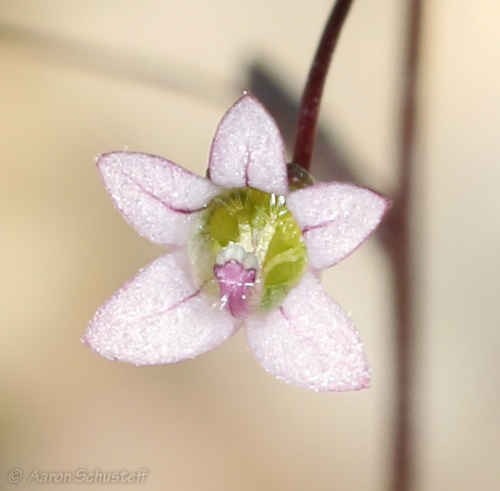
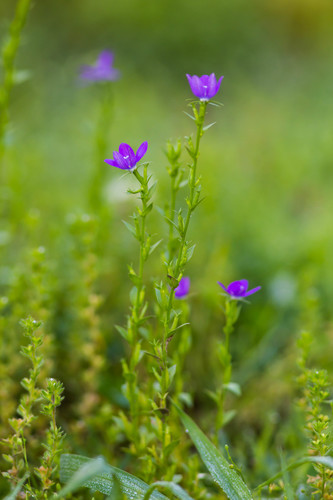
Triodanis biflora, commonly called Small Venus' Looking-Glass, is a flowering plant species in the bellflower family Campanulaceae, belonging to the genus Triodanis. Its common name comes from its similarity to the European species Legousia speculum, which has seeds with a shiny appearance that resembles a looking glass. This annual species is native to the Americas. It is a small, solitary wildflower with purple bell-shaped petals and an alternate leaf arrangement, and it flowers from May to June. It can be found across a wide range of habitats, especially in disturbed areas, distributed through the United States, Mexico, and into South America. This species primarily reproduces through selfing due to its floral system, though it can also be pollinated by various insects. It shares many similarities with the related species Triodanis perfoliata, and the two have a history of hybridization, but they are separated by key differences in floral anatomy and breeding system. Triodanis biflora occupies a broad variety of environments, and occurs most frequently in southern regions. In the United States, it is most commonly found in Eastern Virginia, Kentucky, Kansas, Arkansas, Oregon, and the south central peninsula of Florida, though it can also be found in many other U.S. states and at higher elevations. It also grows in parts of Mexico and South America, consistent with its preference for southern geographies and warmer climates. As a wildflower, it can survive on disturbed lands altered by human activity, in addition to a wide range of other environmental niches. Examples of habitats it occupies include prairies, roadsides, gravel pits, open woods, grassy slopes, and cracks in sidewalks. While it often grows in disturbed areas, it is not limited to them, and can also be found in forests, brush, riparian zones, grasslands, and sandy areas. As a habitat generalist, it can tolerate many different soil conditions, though it is most often found in poor, dry, and sandy soil. This broad tolerance and ability to grow in less favorable soil conditions allows it to avoid competition with other plant species. Because Triodanis biflora has a cleistogamous floral system, it does not have extensive specialized pollinator relationships. Only solitary or occasionally multiple open chasmogamous flowers at the tip of the stem require pollination for outcrossing. All other cleistogamous flowers reproduce through selfing without any external pollination, as pollen from the stamens reaches the stigma of the same flower's female reproductive structure. Both cleistogamous and chasmogamous flowers of this species are generally cosexual, which enables selfing. The plant's stems do not produce aromatic compounds, making it less likely that stems function in pollinator attraction or defense. When outcrossing pollination does occur, the main pollinators are a general group of small bees (which may be eusocial or solitary) and generalist flies including syrphid flies. Specific observed pollinators include plasterer bees, little carpenter bees, bumblebees, small butterflies, and skippers. Because this species does not rely exclusively on outcrossing, specialized form or relationships with pollinators are less important than in many other flowering species, and a wide variety of different insect species can successfully pollinate it.