About Trillium sessile L.
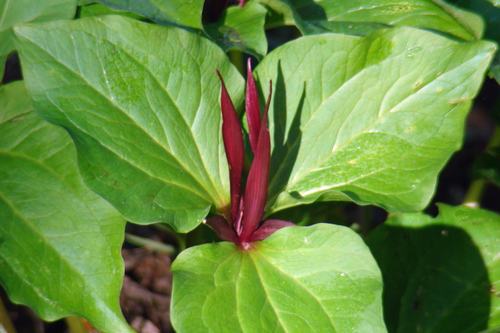
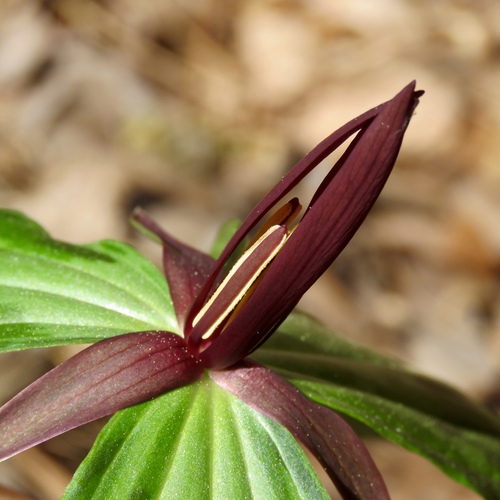
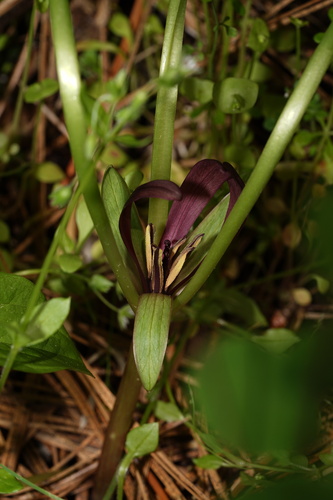
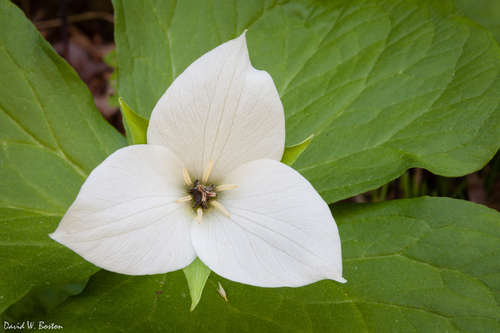
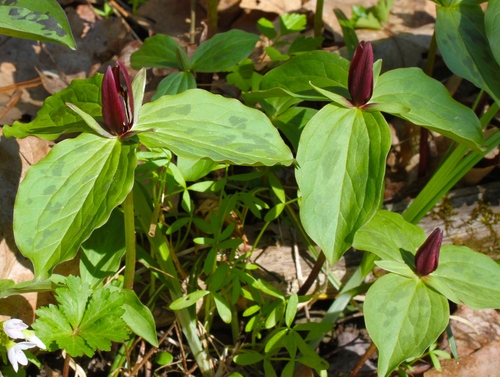
Trillium sessile L. is a perennial, clump-forming herbaceous plant with a thick underground rhizome. Like all trilliums, it has a whorl of three bracts (called leaves here) and one single trimerous flower, with 3 sepals, 3 petals, two whorls of 3 stamens each, and 3 carpels fused into a single ovary with 3 stigmas. Each rhizome produces one or two erect scapes (stems), and each scape grows up to 25 cm (9.8 in) tall. The stalkless (sessile) bracts are elliptic, growing up to 10 cm (3.9 in) long and 8 cm (3.1 in) wide, and they may or may not be mottled. The erect, stalkless flower sits nestled in the center of the three bracts, and gives off a spicy, pungent odor. Sepals are mostly green, but often have purple streaks along their edges or at their base. On average, sepals are 21 mm (0.8 in) long and 5.7 mm (0.2 in) wide. Petals are erect and long-lasting. While their shape and color vary, typical plants have elliptic, reddish-purple petals. The base of each petal is narrowed, and sometimes forms a very short claw-like base around 2 mm (0.1 in) long. On average, petals are 24 mm (0.9 in) long and 6.6 mm (0.3 in) wide, just slightly larger than sepals. Stamens are about half as long as petals, with filaments less than half the length of the inward-facing anthers. The anther connective tissue extends prominently an average of 3 mm (0.1 in) beyond the yellowish-white pollen sacs. The 6-angled ovary is short and squat, topped by three erect, brownish-black stigmas that reach the top of the anther sacs. The fruit is ovoid or nearly round, with an average height of 1.2 cm (0.5 in). It has six prominent ridges that merge into three near the top, one for each persistent stigma that remains through fruiting. A mature fruit is whitish-green with a light pinkish tint, and holds 15–25 golden yellow seeds. The broad range of Trillium sessile overlaps with that of many other sessile-flowered trilliums, which makes identification difficult. For example, T. sessile and T. recurvatum are both native to at least nine U.S. states: Alabama, Arkansas, Illinois, Indiana, Kentucky, Michigan, Missouri, Ohio, and Tennessee. T. recurvatum has distinctive leaves with petiole-like bases and strongly recurved sepals, traits that T. sessile does not have. T. sessile and T. cuneatum are both native to four U.S. states: Alabama, Kentucky, North Carolina, and Tennessee. T. cuneatum is also introduced to other states including Maryland, Michigan, and Pennsylvania. Compared to T. sessile, T. cuneatum has longer petals, shorter stamens, shorter extended anther connectives, and shorter stigmas. In general, T. sessile is a much smaller plant than T. cuneatum. As a species, T. sessile can be identified by anther connectives that extend prominently above its inward-facing (introrse) anthers. Its elongated, erect stigmas are usually more than 1.5 times the length of the relatively short, nearly spherical, sharply angled ovary. Its bracts are often not mottled, and any mottling fades as the season progresses. While T. sessile plants are usually smaller than related species, they can grow quite robust under favorable conditions, so absolute size is not a reliable distinguishing trait. Relative sizes and proportions are useful for identification: the scape is roughly three times as long as a bract; the ratio of average width to average length of sepals is 1:3.6; the ratio of average width to average length of petals is 1:3.65; the ratio of average sepal length to average petal length is 1:1.16; the ratio of average stamen length to average petal length is 1:1.7; filaments are less than half the length of anthers; stigmas are usually 1.5–2 times as long as the ovary. In areas where multiple sessile-flowered Trillium species grow together, T. sessile usually flowers earlier. Trillium sessile is endemic to the eastern half of the United States, ranging from Maryland in the east to the Ozarks in the center of the Mississippi Basin, and from the southern Great Lakes region to northern Alabama. This species occurs in more U.S. states than any other sessile-flowered trillium. It is found east of the Mississippi River in Alabama, District of Columbia, Illinois, Indiana, Kentucky, Maryland, Michigan, New York, North Carolina, Ohio, Pennsylvania, Tennessee, Virginia, and West Virginia. It is found west of the Mississippi River in Arkansas, Kansas, Missouri, and Oklahoma. It is most abundant in Ohio, Indiana, northern Kentucky, and Missouri, but is unexpectedly absent from central Illinois, creating a distribution gap between the species' eastern and western subpopulations. Plants from the western subpopulation, centered in Missouri, often have taller scapes (stems) and narrower bracts (leaves) than plants from the eastern subpopulation. It is unknown whether this geographic difference is caused by genetic or environmental factors. T. sessile grows in rich woods, particularly in limestone areas and on calcareous soils. It also grows on alluvial floodplains and riverbanks, and occasionally on less fertile soils. It grows alongside other Trillium species (depending on location), bleeding-hearts (Dicentra spp.), Hepatica spp., Virginia bluebells (Mertensia virginica), mayapple (Podophyllum peltatum), woods-poppy (Stylophorum diphyllum), and violets (Viola spp.). It can tolerate significant disturbance and habitat degradation, persisting under light pasturing, along fence rows, and in brushy areas after logging. As of October 2019, T. sessile is globally secure, but it is vulnerable or worse in eight U.S. states. It is critically imperiled in the District of Columbia, New York, North Carolina, and Oklahoma specifically. Trillium sessile flowers in April across most of its range. In the southern part of its range, it can flower as early as late March, while its northernmost populations may not flower until mid-May. In Tennessee, fruits have been observed ripening and dropping between June 20 and July 5. The above-ground parts of the plant die back by mid-summer, but may persist longer in areas that do not dry out completely. The pungent odor of its flowers attracts its primary pollinators, flies and beetles. Most Trillium species are myrmecochorous, meaning ants facilitate seed dispersal for most if not all species. Since T. sessile seeds have attached elaiosomes, its seeds are presumed to be dispersed by ants as well. Some sources note that the cooked greens of this plant may be edible as an emergency food, but the entire plant, and especially the root, is known to induce vomiting. The fruit is suspected to be poisonous. Trillium sessile has been used medicinally to treat tumors. It is sometimes claimed to have been used as a poultice for boils and as a panacea-like decoction, but this claim is doubtful, as it is attributed to the Yuki and Wailaki Native American tribes of California, where this species is not known to occur. Trillium sessile is sometimes grown in woodland wildflower gardens. Like many trilliums, it often does not survive transplanting from the wild.