About Trillium luteum (Muhl.) Harb.
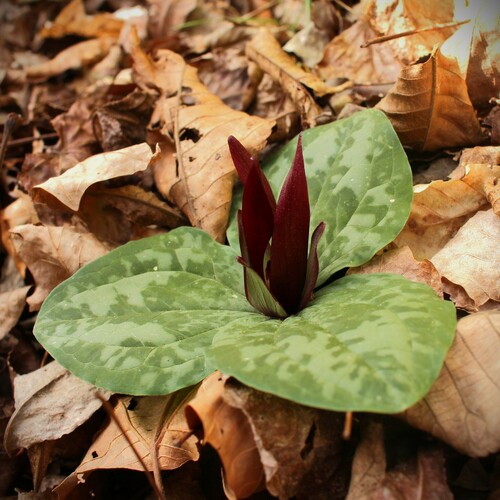
Trillium luteum (Muhl.) Harb. is a perennial herbaceous flowering plant that survives via an underground rhizome. Like all trilliums, it has a whorl of three bracts commonly called leaves, plus a single trimerous flower with three sepals, three petals, two whorls of three stamens each, and three carpels fused into a single ovary with three stigmas. This species has a stalkless sessile flower, erect petals, and mottled leaves. It reaches up to 40 cm (16 in) tall and 30 cm (12 in) wide, and produces lemon yellow, scented blooms. Its large, stalkless triple leaves often have grey-green marbling across their surfaces. It flowers from April to May beneath the bare branches of deciduous trees. After flowering and setting seed, it enters summer dormancy, and re-emerges in late winter. In the wild, Trillium luteum is endemic to the southeastern United States, where its natural range extends from southeastern Kentucky to northwestern Georgia. It has large, significant populations in and around the Great Smoky Mountains of eastern Tennessee and western North Carolina, and is especially abundant near Gatlinburg, Tennessee. This species has been widely introduced outside its natural range, with established known populations in Maryland, Michigan, Ontario, Pennsylvania, South Carolina, and Virginia. There are hundreds of citizen science observations of Trillium luteum outside its natural range, most notably in Pennsylvania, Maryland, New York, and Virginia. A few separate disjunct populations of yellow sessile-flowered trilliums in central Alabama have been classified as T. luteum, but botanists do not agree on this classification. The natural ranges of T. luteum and T. cuneatum generally do not overlap; overlapping only occurs in Casey County (southern Kentucky), southeastern Tennessee, and along the Little Tennessee River on the Tennessee-North Carolina border. Hybrids form at these overlapping contact zones, which makes species identification difficult. For cultivation, this plant is hardy down to −15 °C (5 °F). It needs a sheltered position with rich, moist leafmould in a shaded deciduous woodland setting that replicates its native habitat in North American broadleaf forests. It must be left undisturbed to grow into a large colony. Growing it successfully requires some gardening experience, but the species has still earned the Royal Horticultural Society's Award of Garden Merit.