About Trillium hibbersonii (T.M.C.Taylor & Szczaw.) D.O'Neill & S.B.Farmer
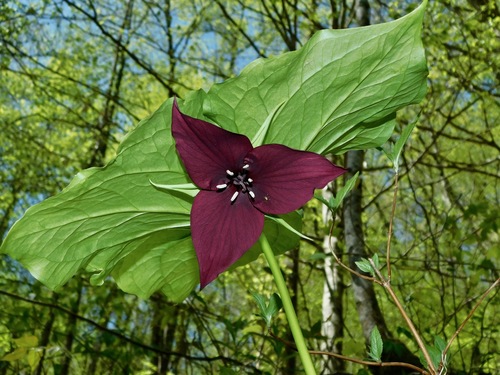
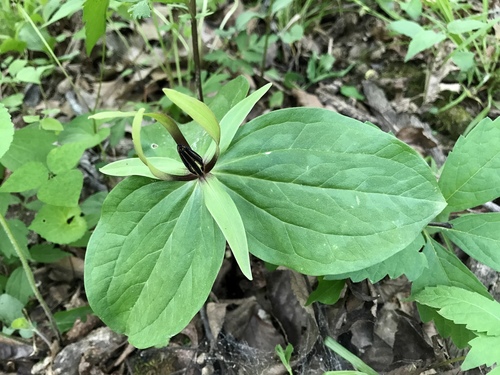
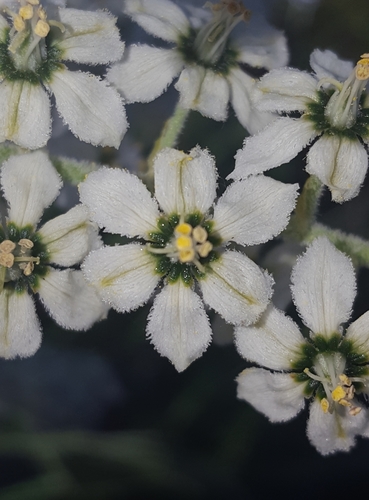
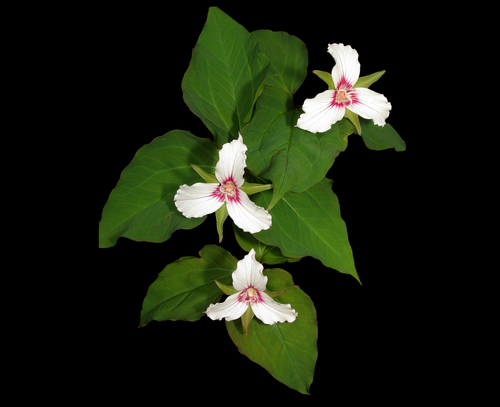
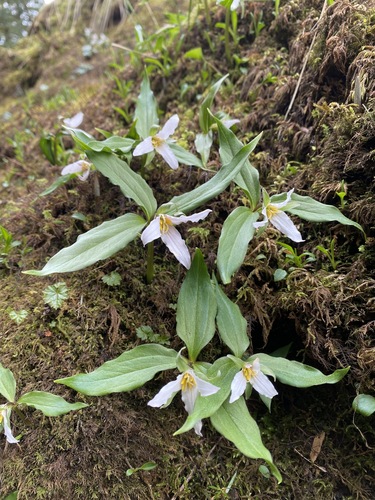
Trillium hibbersonii is a perennial herbaceous plant with a reddish scape (stem) that grows between 1.0 and 8.2 cm (0.39 to 3.23 inches) tall. Like all trilliums, it has a whorl of three bracts (leaves) and a single trimerous flower. This flower structure includes 3 sepals, 3 petals, two whorls of 3 stamens each, and 3 carpels fused into a single ovary with 3 stigmas. The flower sits on a short stalk called a pedicel; it opens pink and darkens to dark pink as it ages. The bracts measure 3.3 to 5.3 cm (1.3 to 2.1 in) long and 1.3 to 2.5 cm (0.51 to 0.98 in) wide, with reddish edges. The average ratio of bract length to width is 2.3, and this value does not change across the growing season. The two halves of each bract are often held at an angle relative to the bract's longitudinal axis. The pedicel averages 1.1 cm (0.43 in) in length, is streaked with red, and is bent so that the flower faces outward at approximately 45 degrees. Like the bracts, the green sepals have reddish edges. The petals are ovate to elliptic, with an average length of 2.0 cm (0.79 in). The stamens are roughly half the length of the petals and do not extend past the stigmas. The creamy-white filaments are shorter than the anthers, and the outward-facing side of the anther connective tissue is purple. The ovary ranges in color from yellow-green to red-brown, is ridged, and does not have prominent wings. The fruit is a berry-like capsule that dehisces irregularly. Trillium hibbersonii is distributed on the west coast of Vancouver Island, British Columbia. When it was originally described, it was thought to occur occasionally across the full range of the species, but this is no longer accepted as correct. There are only four known populations of T. hibbersonii, all located on Vancouver Island, so the species is a focus of conservation concern. Most Trillium species are myrmecochorous, meaning ants facilitate their seed dispersal. Trillium seeds have a white fleshy appendage called an elaiosome that attracts ants. Because every Trillium hibbersonii seed has an attached elaiosome, it is presumed that its seeds are also dispersed by ants. After dispersal, most Trillium seeds have a type of dormancy called morphophysiological dormancy, also known as "double dormancy", which requires two full winters to break dormancy completely. Trillium hibbersonii apparently does not have this requirement. In a single experiment, 90% of T. hibbersonii plants broke dormancy after just one cold period.