About Trigonodes hyppasia (Cramer, 1779)
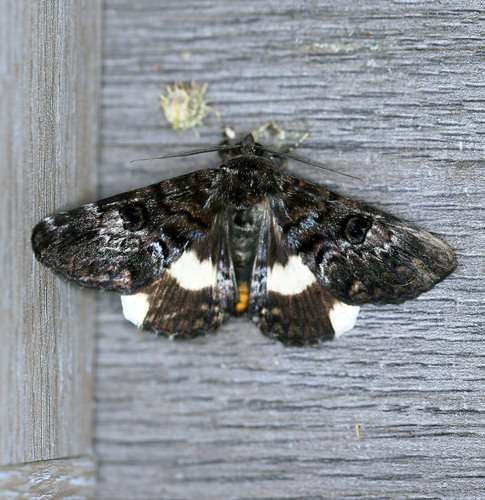
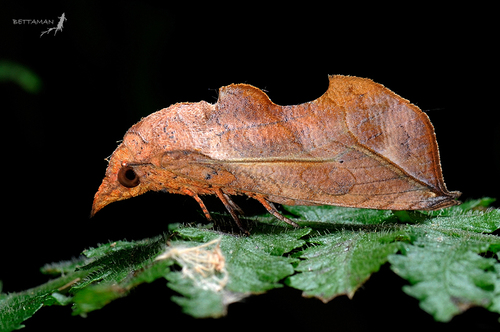
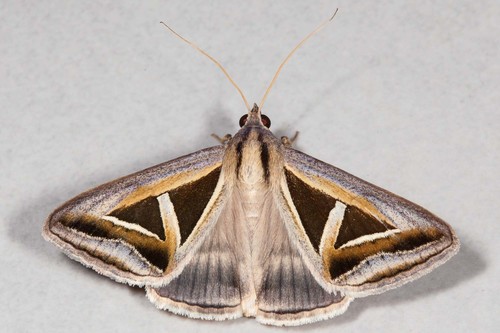
This species, Trigonodes hyppasia (Cramer, 1779), has a wingspan of approximately 30 to 46 mm. In males, the antennae are ciliated, and the mid and hind tibiae are covered in hairs. The body is pale ochreous brown, with a slight suffusion of fuscous or dark grey brown. On the forewings, a large black triangular patch with a white edge is easily visible below the cell, extending from near the base toward the outer angle. A similar smaller patch is located beyond the cell on vein 5, with some pale fulvous coloration behind it. A slightly sinuous pale submarginal line has patches of black suffusion inside it and a series of black specks beyond it. A dark marginal line is also present. The hindwings have an indistinct medial line and an outer area suffused with fuscous. The larva has a yellow upper half and a brown ventral section. The yellow portion is interrupted by longitudinal brown bands, which fade toward the posterior of the body and become more intense again on the prolegs. Eggs are olive green with speckled rusty red markings. The first few larval instars are green with three lateral purple brown lines, while late instars are yellowish. The pupa develops inside a thin cocoon of white silk, which is spun among leaves. The larvae feed on species of the genera Chrysopogon, Eleusine, Glycine, Indigofera, Kummerovia, Medicago, Phaseolus, Rhynchosia, and Nephelium.