About Trigonoceps occipitalis (Burchell, 1824)
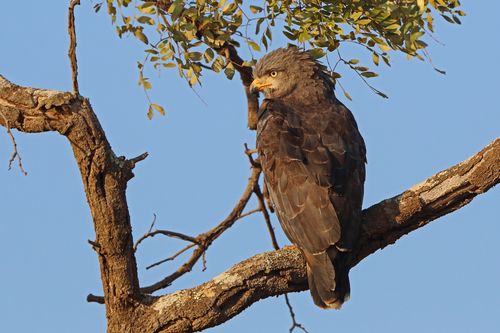
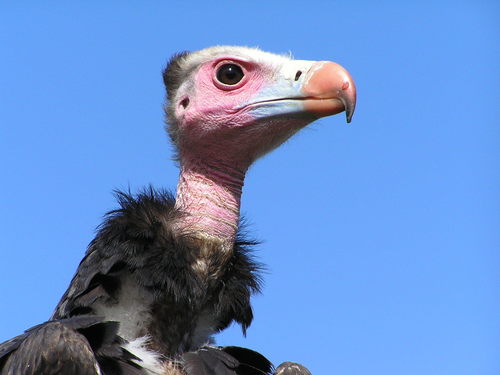
This species, commonly known as the white-headed vulture, has the scientific name Trigonoceps occipitalis (Burchell, 1824). The white-headed vulture is a medium-sized vulture, measuring 72–85 centimetres (28–33 in) in length, with a wingspan of 207–230 centimetres (81–91 in). Females have an average weight of 4.7 kilograms (10 lb), while males are generally lighter at 4 kilograms (8.8 lb) or less. This species is unique among African vultures because it displays a degree of reversed sexual dimorphism, meaning females are somewhat larger than males. It has a pink beak and a white crest, and the featherless areas on its head are pale. It has dark brown upper parts and black tail feathers. The feathers on its lower parts and legs are white, creating its distinct appearance when viewed from below. These vultures can be easily distinguished from all other vulture species by the strong black-and-white contrast in their plumage. Individual white-headed vultures can also be reliably identified by a unique pattern in their median wing coverts. The white-headed vulture is widely distributed across sub-Saharan Africa, ranging from Senegal and Gambia east to Somalia, and south to South Africa and Eswatini. It is locally uncommon to common across its range. An older total population estimate placed the species at 10,500–18,750 individuals, but newer estimates following recent population declines put the total at just 5,500 individuals. It is estimated that 400 protected areas contain 1,893 white-headed vulture nests: 721 nests are in East Africa, 548 in Central Africa, 468 in Southern Africa, and 156 in West Africa. The species prefers mixed, dry woodland at low altitudes. It occurs at elevations up to 4,000 m (13,000 ft) in Ethiopia, and up to around 3,000 m (9,800 ft) in Kenya. In Botswana, it can be found in thorny, Acacia-dominated landscapes. It generally avoids human habitation, and is largely restricted to protected areas. For example, Kruger National Park and neighboring conservation areas hold the largest population of the species in South Africa. The white-headed vulture is a long-lived, resident species that appears to be loyal to its territory. It builds nests in trees, mostly acacias or baobabs; Senegalia species are also preferred. Nests are placed on the top of the canopy in low-relief, flatter areas. These vultures usually lay a single egg a couple of months after the rainy season ends, once the dry season has started. It is generally a solitary species, and nests in isolated, likely territorial pairs. A study of 73 pairs recorded an average productivity of 0.69 chicks per pair across 55 breeding attempts. White-headed vultures have a characteristic breeding behavior. A study conducted in Kruger National Park found that copulation only occurs on the nest, and is described as a subtle, inconspicuous process that lasts approximately 15 to 20 seconds. Before copulation, the female stands perpendicular to and in front of the male. The "head turning" behavior typically observed in other aegypiine vultures was not seen in this species. The sound the birds make during copulation is unusual, and is best described as a very deep squeak that is longer than a grunt. The white-headed vulture is predominantly a carrion-eater. It frequently flies lower than other vulture species, and is often the first species to arrive at a carcass. However, the species is probably also an active predator when the opportunity arises. Instances of pairs preying on species including the slender mongoose (Galarella sanguinea), monitor lizard (Varanus spp), tree squirrel (Paraxerus cepapi) and scrub hare (Lepus saxatilis) have been recorded. In three of these four recorded events, cooperative behavior between the paired birds was apparent, which suggests this behavior is not uncommon. No observable agonistic behavior occurred between the birds while feeding, and the birds appeared practiced and unaffected by the presence of an observer. These observations suggest the vulture may be a regular facultative predator. However, extensive field reports are still lacking, so further research is needed. In addition, the visual field of this vulture species is more similar to other predatory species such as accipitrid hawks than to that of more closely related, carrion-feeding Gyps vultures. Specifically, white-headed vultures have a significantly wider binocular field (30°, compared to 20° for Gyps vultures), which is thought to help with the accurate placement and timing of talons needed to capture live prey.