About Trifolium barbigerum var. andrewsii A.Gray
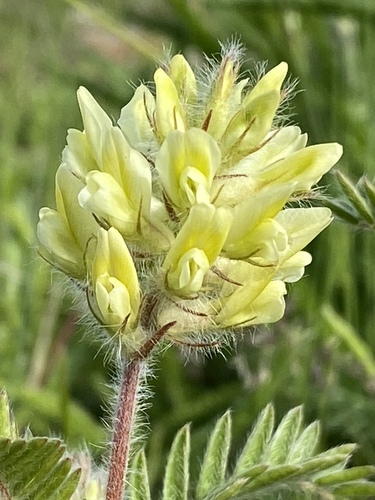
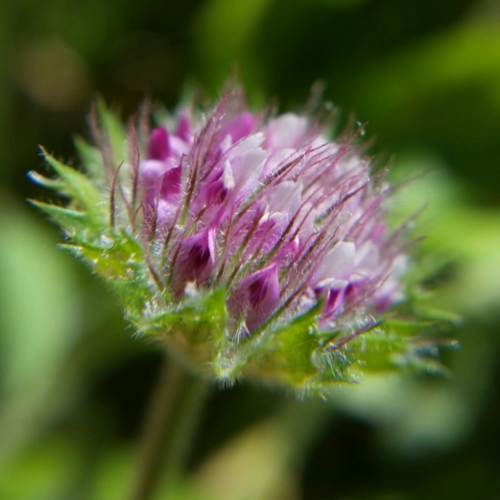
Trifolium barbigerum is an annual herb that grows in a decumbent to erect form, and has a texture ranging from hairy to hairless. Its leaves are divided into oval leaflets that can reach up to 2.5 centimeters long, and some leaflets have notches at their tips. The leaf stipules are large and variable in shape. The inflorescence is a head of flowers up to 2.5 centimeters wide. The flowers are held in a bowl-shaped involucre of bracts with toothed edges. Each flower has a calyx of sepals that narrow into one or more bristles coated with long hairs. Inside each calyx is the flower corolla, which may be pinkish purple, white, or bicolored purple and white. The bloom period runs from April to July. This variety is native to central coastal and Northern California as well as Oregon, growing at elevations below 700 metres (2,300 ft). It occurs on the northern Channel Islands of California, in the California Coast Ranges, and around the San Francisco Bay Area. It grows in many habitat types, including coastal prairie, mixed evergreen forest, closed-cone pine forest, and wetland-riparian areas. It can also be found in disturbed and cultivated areas.