About Trifolium alpinum L.
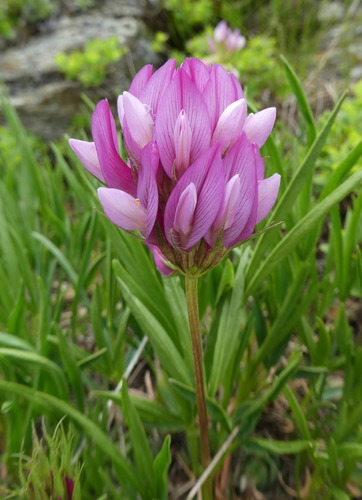
Trifolium alpinum L., commonly called alpine clover, is a flowering plant species in the legume family. It is a perennial herb with a large taproot that can reach 1 metre long and 1 centimetre wide. Its short stems carry ternate leaves, which are split into three leaflets that each grow up to 5 cm long. Flowers bloom from June to August; they are fragrant, 18–25 millimetres long, and arranged in globose heads that hold up to twelve individual blossoms. The corolla is most often pink to light red, with a purple tinge. The root of this plant has a clear sweet flavour, similar to liquorice. In alpine areas, this species acts as an important source of forage for livestock, and it is also effective at stabilizing erosion sites at high elevations. Trifolium alpinum is native to the Alps, Pyrenees, and northern Apennines. It grows in subalpine and alpine climates at elevations between 1700 and 2800 m, and can sometimes grow as high as 3100 m. It is most commonly found in rocky meadows and poor alpine grasslands, and prefers deep, warm, nutrient-deficient acidic soils. The plant's strong fragrance is a multi-functional adaptation to its high-altitude environment. As a self-incompatible species, it depends fully on insects for pollination and seed production. The potent scent works as a long-range chemical beacon to attract pollinators, especially honey bees and bumblebees. The same volatile compounds that create the scent may also work as a chemical defense to discourage herbivores. The production of secondary metabolites like terpenes and phenolics is also a physiological response that alpine plants use to handle high levels of abiotic stress, including intense UV radiation. Trifolium alpinum is valued as a nutrient-rich, digestible forage crop for livestock, including cattle, sheep, chamois, and marmots. Thanks to its very deep taproot and nitrogen-fixing abilities, it is also used in ecological restoration projects to stabilize soil on eroded high-altitude slopes. In ethnobotany, the plant is recognized for its sweet, liquorice-flavoured root, which was traditionally eaten as a confection in some alpine regions. In German folk medicine, a root decoction has been used to treat chest complaints.