About Trifolium alexandrinum L.
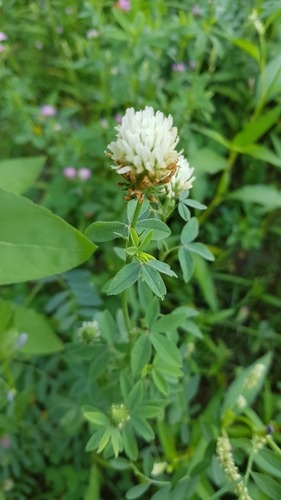
Trifolium alexandrinum, commonly called Egyptian clover or berseem clover, is an annual clover species native to northeast Africa and southwest Asia, ranging from Egypt eastward to Pakistan. Individuals grow 45 to 75 cm (18 to 30 in) tall, with erect or ascending stems, and have a growth habit similar to that of red clover. Its leaves are trifoliate, with slender leaflets. Its flowers range from white to creamy white, and are borne in inflorescences similar to those of white clover, holding around 100 flowers each. Egyptian clover is mainly cultivated in irrigated subtropical regions, and is used as a leguminous crop. It is an important winter crop in Egypt, where it may have been cultivated since ancient times; it was introduced to northern India in the early 19th century. It is also grown outside its native range in northern Africa west of its native distribution, as well as in Australia, China, Europe and the United States, and has become locally naturalized as far north as England. There are two agricultural cultivar groups of berseem clover: single-cut and multi-cut. Single-cut cultivars such as 'Balady' have a high growing point and recover poorly after harvest. Multi-cut cultivars such as 'Frosty' have a lower growing point, which allows multiple harvests from a single sowing. In general, berseem clover is frost-sensitive, and should only be planted after the risk of frost has passed. The 'Frosty' variety is an exception; it was developed by Grassland Oregon, Inc. and released in 2016, and can survive temperatures as low as −15 °C (5 °F).