About Trichopteryx carpinata (Borkhausen, 1794)
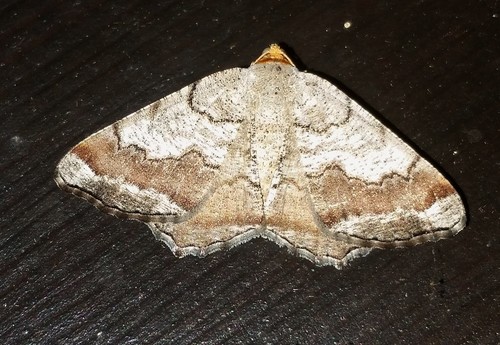
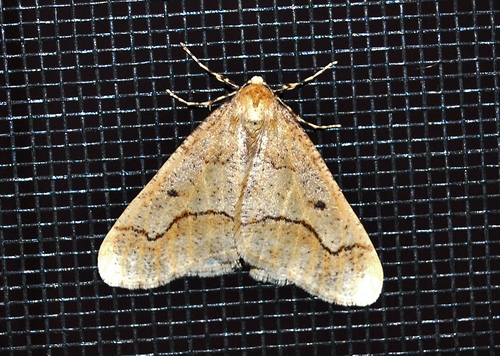
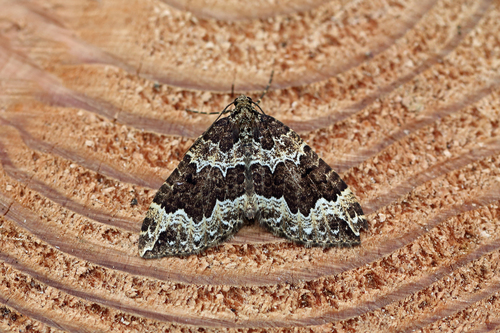
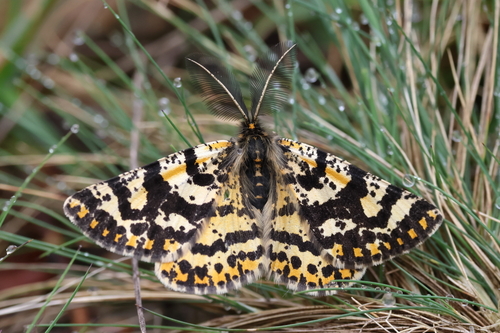
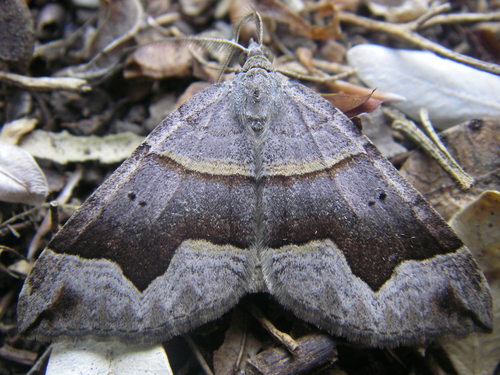
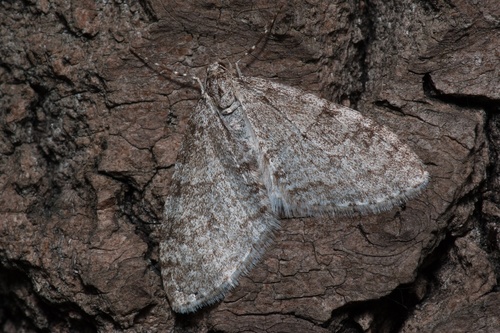
Trichopteryx carpinata, commonly known as the early tooth-striped, is a moth species belonging to the family Geometridae. It was first described by Moritz Balthasar Borkhausen in 1794. This species is distributed across most of Europe, excluding Iceland, Greece, Sicily, Sardinia, and Croatia; its range extends east through the eastern Palearctic realm, reaching the Russian Far East, Siberia, and the Ile District of Kazakhstan. The wingspan of adult moths measures 30 to 34 mm. The forewing ground colour is whitish grey, with a very faint green tinge in freshly emerged individuals; markings are a slightly darker brownish grey and are generally quite weakly expressed. The hindwing is whitish, becoming greyer toward the distal edge, and sometimes has one or two fairly well-defined grey lines close to the distal margin. Males have narrower wings than females. The aberration fasciata Prout has much darker two central bands, sometimes a quite deep fuscous colour, that make the moth appear to be a different species; this aberration is frequent in Perthshire. The form obscurata Sp. Schneid., described as a local race from Norway, is possibly transitional toward aberration fasciata, as its bands and lines are reported to be more distinct. Unlike fasciata, obscurata also has a darkened ground colour. The aberration unifasciata Rbl. is a development of fasciata where the two central bands merge along their posterior section, leaving only a pale central area in the anterior portion, similar to what is seen in the species Trichopteryx polycommata. The larva of Trichopteryx carpinata is hairless and green, marked with narrow white longitudinal stripes. Adults fly from April to May, and the species has one generation per year. Larvae feed on a variety of trees, including Lonicera, Salix, and Betula.