About Trichonephila plumipes (Latreille, 1804)
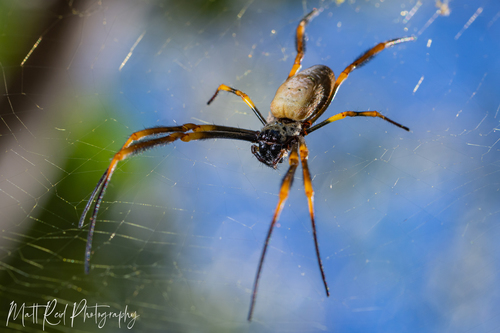
Trichonephila plumipes shares the general body form common to most other members of the Trichonephila genus. Female T. plumipes resemble female T. clavipes in having a group of stiff hairs on their legs, but the hairs of T. plumipes are arranged more closely together than those of T. clavipes. Female T. plumipes have a black cephalothorax covered in silver-colored hairs. The abdomen is olive-brown, marked with yellow and white spots and stripes, and several leg pairs bear brushes of stiff black hairs. Male T. plumipes have dark brown bodies and dark brown legs, with only a small scattering of black hairs and none of the hair brushes seen in females. T. plumipes integrates prey it has already captured into its web, using a long-term food storage mechanism. It creates a densely packed storage band of uneaten previously captured prey within its web, which attaches to the barrier web near the web hub. When prey capture rates are low, T. plumipes can maintain its body mass by consuming these stored prey items. Unlike T. plumipes, which only stores animal material in this storage band, some other Trichonephila genus species use plant material in their storage for unidentified non-food-related functions. A disadvantage of this hoarding behavior is that stored prey items may be lost to kleptoparasites or through web damage. Spiders of the Trichonephila genus are commonly hosts to kleptoparasitic spiders, and food storage in the web can attract more of these kleptoparasites. However, one study found that the abundance of kleptoparasites does not affect weight gain in T. plumipes, as kleptoparasites feed on prey items that the host spider ignores, which does not change the host spider’s nutrient intake.