About Tricholomopsis rutilans (Schaeff.) Singer
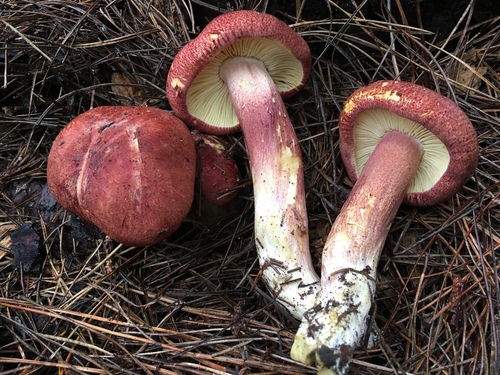
Its common name comes from its plum-red scaled cap and custard-yellow gills. The cap starts convex, becomes bell-shaped, then flattens as it ages. It reaches up to 12 centimetres (4+1⁄2 in) wide, with an incurved margin, and is densely covered in red to purplish-red hairs. As the mushroom matures, these hairs bunch into small scales, revealing the yellowish tissue underneath. A KOH test turns the cap surface red. The gills are adnate, yellow, closely spaced, and include many short gills. The stem measures 5–11 cm (2–4+1⁄4 in) tall and 8–25 mm (3⁄8–1 in) thick; it has a red scaly base that fades to yellow towards the gills, and may become entirely yellow with age. The flesh is yellow to cream-colored, and the spore print is creamy white. Spores are cream colored, 5–7 x 3–5 μm, almost globular to broadly ellipsoid, smooth, and glass-clear in KOH. Basidia have 4 protrusions. Cheilocystidia are 50–70+ x 20–25 μm, ranging from ball-on-stick shaped to sack shaped or irregularly swollen, smooth, thin-walled, and clear in KOH. Pleurocystidia are scattered, 30-35 x 5–7 μm, flask shaped to nearly cylindrical, smooth, and clear in KOH. Tricholomopsis rutilans grows on tree stumps and logs, especially spruce logs, in coniferous woodlands across the northern hemisphere, and can be found from late summer to autumn, between June and November, in locations including Ireland, Bulgaria, Ukraine and northwest Russia. It has also been found, likely accidentally introduced, on introduced pine trees in Australia, Aotearoa New Zealand and Costa Rica. This species is saprobic on well-decayed conifer wood, and is also occasionally reported growing in woodchips, sawdust, and lignin-rich soil. It grows alone, scattered, or in groups, and is widely distributed in North America.