About Tricholoma vaccinum (Schaeff.) P.Kumm.
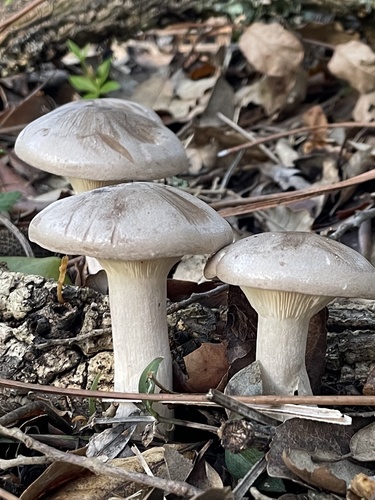
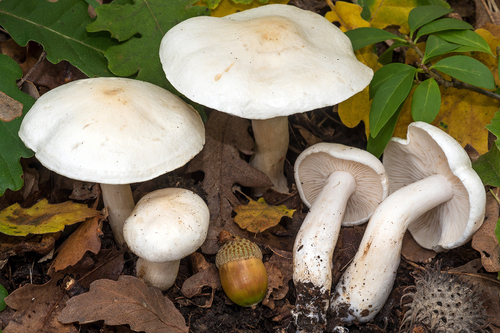
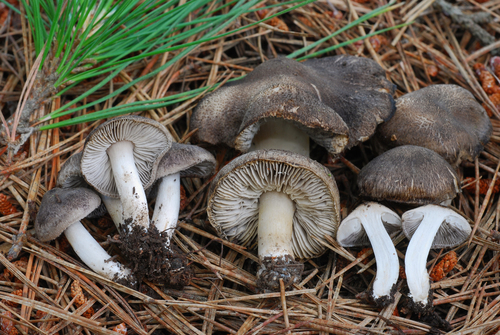
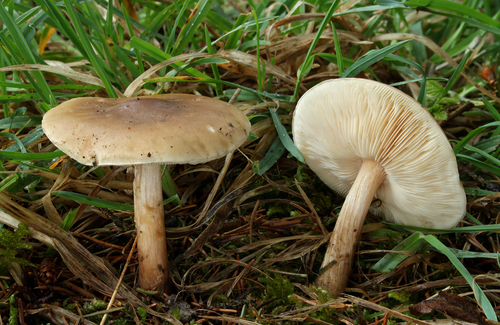
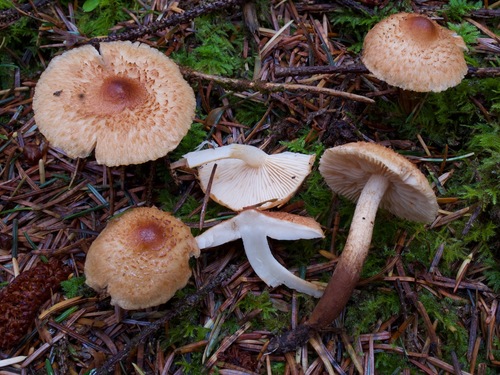
Tricholoma vaccinum (Schaeff.) P.Kumm. is an ectomycorrhizal mushroom that associates with coniferous trees, particularly pine and spruce. Its cap starts broadly conical, becomes convex, and eventually flattens out, with a diameter typically ranging from 2.5 to 8 cm (1 to 3 in). The cap margin is initially curved inward, and shaggy due to hanging partial veil remnants; the cottony partial veil does not leave a ring on the stipe. The cap surface is fibrous to scaly, and ranges in color from reddish-cinnamon to brownish-orange to tan. Gills attach to the stipe in an adnate to sinuate pattern and are closely crowded. There are between 3 and 9 tiers of lamellulae—short gills that do not reach all the way from the cap edge to the stipe. Gills are dingy white and often develop reddish-brown stains. The stipe measures 3 to 8 cm (1 to 3 in) long and 1 to 2 cm (0.5 to 1 in) thick, is roughly equal in width along its length, and becomes hollow as it ages. Its color ranges from whitish to a lighter shade of the cap color, sometimes with reddish-brown stains, and it is paler near the apex. Like the cap, the stipe surface is fibrous to scaly. Fruit bodies have an unpleasant odor, produce a white spore print, and have broadly elliptical, smooth, hyaline (translucent), inamyloid spores that measure 6–7.5 by 4–5 μm. The four-spored spore-bearing basidia measure 17–32 by 6.0–7.5 μm and lack clamps. The hymenium has no cystidia. The cap cuticle hyphae are arranged in either a cutis (parallel to the cap surface) or trichoderm (perpendicular to the cap surface). These hyphae are roughly cylindrical, 3.5–8.0 μm wide, with roughly cylindrical to club-shaped ends that measure 6.0–11.0 μm wide. No clamp connections are present in T. vaccinum hyphae. Its ectomycorrhizae are classified as "Medium-Distance fringe exploration type", which describes the species' soil space occupation, potential nutrient acquisition reach, and carbohydrate investment required from host trees. Fruit bodies typically grow in groups or clusters on the ground, sometimes among moss, fruiting during late summer and autumn. T. vaccinum is distributed across northern Asia, Europe, and North America, where it is widespread throughout the United States and Canada, and has also been recorded in Mexico. It is one of the most common Tricholoma species in Central Europe, often found in large groups in spruce forests. It is rare in the United Kingdom, with most records coming from Scotland, and may be extinct in the Netherlands. The ectomycorrhizae of T. vaccinum have been the subject of substantial research. Ectomycorrhizal structure differs considerably among Tricholoma species, and differences in rhizomorph (cord-like hyphal fusions that resemble roots) structure are used to distinguish species. Ectomycorrhizae formed with Norway spruce (Picea abies) are noticeably hairy from numerous hyphae. Hyphae are partly densely interconnected into rhizomorphs that have pigment in their outer membrane. Emanating hyphae mostly lack fully developed contact septae and contact clamps, and rhizomorph hyphae vary widely in diameter. The Hartig net (a network of hyphae that extends into the host root) formed by T. vaccinum grows deeper toward the root epidermis, is made of more rows of hyphae, has more tannin cells near the epidermis, and therefore has fewer cortical cells in that region. Rhizomorphs make their closest contact with host rootlets at this region near the epidermis. The fungal mantle surrounding the root is prosenchymatous, meaning its hyphae are loosely arranged with open spaces between them. Techniques including freeze fracturing and scanning electron microscopy have been used to study the ectomycorrhizal microstructure, including inner mantle thickness and the interface between the Hartig net and host cells. Multiple fungal genes specifically expressed during the ectomycorrhizal interaction between T. vaccinum and Picea abies have been identified, including genes involved in plant pathogen response, nutrient exchange, plant growth, signal transduction, and stress response. The first characterized fungal aldehyde dehydrogenase enzyme, ALD1, helps the fungus manage ethanol stress, a critical function in mycorrhizal habitats. While T. vaccinum fruit bodies have sometimes been classified as edible, they are low quality and reported to be mildly poisonous. They are not recommended for consumption because they resemble toxic brown Tricholoma species. Orson K. Miller, Jr. classified them as "bitter and not edible". Fruit bodies can be used to produce yellow dyes for coloring wool and other fibers.