About Tricholoma portentosum (Fr.) Quél.
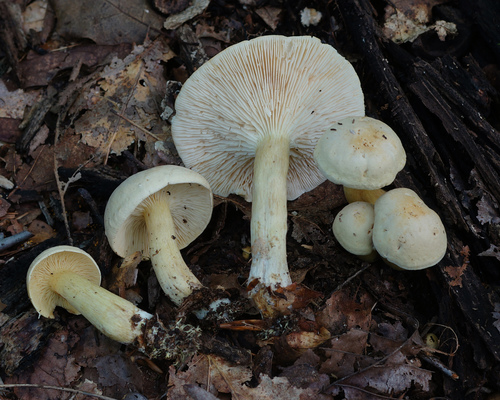
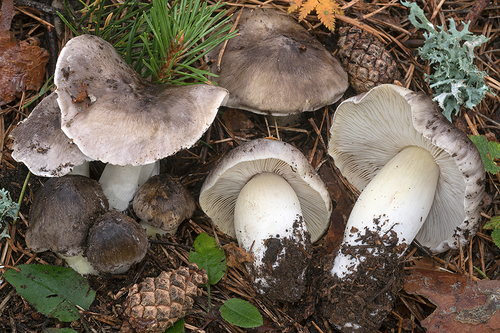
Tricholoma portentosum (Fr.) Quél. is a large, robust mushroom that has a convex cap 3–11 cm (1–4.5 in) across with a prominent central boss. The cap is sticky when wet, has an irregularly lobed margin, and is dark grey with darker grey to blackish streaks that run perpendicular to the cap margin. The grey color lightens toward the margin, and the cap may carry a yellow or purple tinge. The gills are crowded, attached to the stipe, and white; the solid stipe is white with a yellow tinge near the top. The stipe is 3.5–12 cm (1.4–4.7 in) tall and 1–3 cm (0.4–1.2 in) wide. This species produces a white spore print, and has a flour-like farinaceous smell and taste. This is an ectomycorrhizal species; its fruit bodies appear in late autumn in coniferous woodland across Europe and North America. It is most commonly associated with Pinus sylvestris, and can sometimes be found growing with oak (Quercus) or beech (Fagus) on sandy soils. It is a holarctic species, and a 2017 study found it shares the same genetic profile across all three continents where it occurs. Since the 1980s, this species has declined in the Netherlands, where it is now rare. It is uncommon in Britain, but common in France, where it can sometimes be found in wild mushroom markets. It remains common in Western Europe in Scotland, France, the Northern Iberian Peninsula, and Italy. It is also common in Central Europe, specifically Germany, the Czech Republic, Slovakia and Slovenia, and in Eastern Europe, where it occurs in Estonia, Belarus, Bulgaria, Ukraine and Russia. In North America it is common in the east, most notably in Quebec, New Hampshire, Maine, Massachusetts, and Connecticut. In Asia, it is widespread in Russia, Kyrgyzstan, China, and Japan. Older fruit bodies of this species are often eaten by slugs. Tricholoma portentosum is held in high regard as an edible mushroom, but some sources do not recommend eating it due to its close similarity to toxic species. It is recommended that the stem be removed before cooking, and the mushroom can be pickled.