About Tricholoma pardinum (Pers.) Quél.
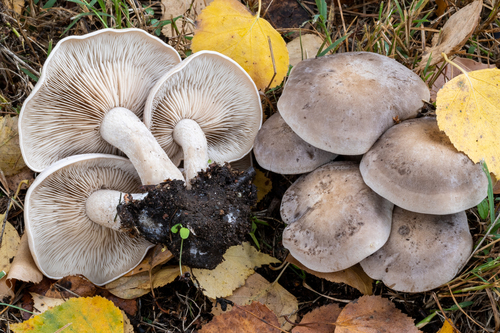
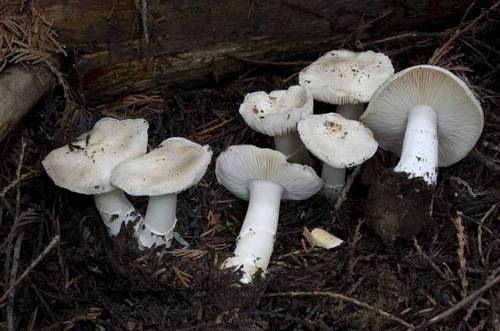
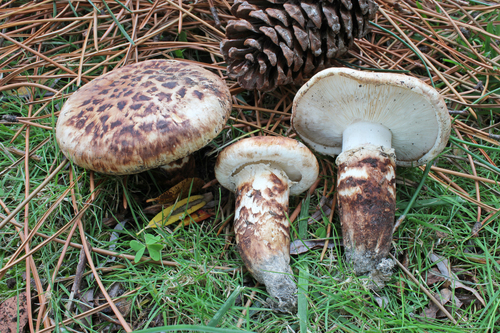
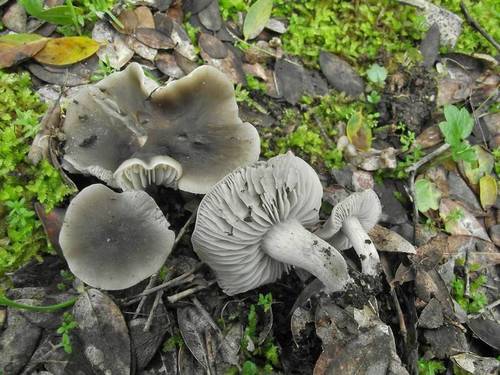
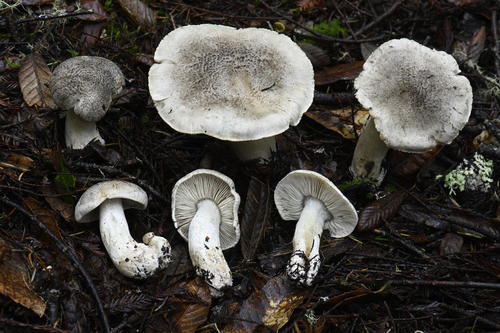
This medium-sized mushroom, Tricholoma pardinum, has a cap that measures 5–15 cm (2–6 in) in diameter. The cap starts hemispherical, flattens as it matures, and features a broad, shallow umbo. Its margin is initially curled inward and unfurls with maturity. The cap surface is silvery-grey, covered in concentrically arranged darker grey, brown, or blackish scales that fade in color toward the margin; Secretan noted this cap resembles the cap of Sarcodon imbricatus. Its gills are free (not attached to the stalk), thick, and white, and may develop a yellow or greenish tint. Both broken gills and broken stalk tops can drip water. As gills age, their edges become jagged and rough. Gill spacing ranges from distant to crowded, with typically 100–120 full gills stretching from the stalk to the cap edge, plus a variable number of shorter partial gills called lamellulae. The stout stalk is 3–12 cm (1–4.5 in) tall, 1.5–3 cm (0.5–1 in) wide, and thicker at its base, which measures 2.5–4 cm (1–1.5 in) in diameter. The stalk may be white, pale grey, or pale brown; its surface texture ranges from fibrillose (with coarse longitudinal fibers) to nearly smooth. Bruising the stalk base turns it a dirty brown to yellow, and the whole stalk bruises dirty yellow. There is no ring or volva on the stalk. The flesh is whitish, with a pleasant mealy smell and taste; the variety filamentosum has a mealy flavor and odor that resembles cucumber. The spore print is white. Spores are oval to oblong, measuring 7.5–9.5 μm long by 5.0–7.0 μm wide; they are smooth, translucent (hyaline), nonamyloid, and have a prominent hilum. The spore-bearing basidia are cylindrical to club-shaped, four-spored, and measure 39–50 by 8.0–9.6 μm. Cheilocystidia (cystidia on the gill edge) are thin-walled, hyaline, with a short stalk and spherical apical portion, measuring 29–41 by 12–21 μm; cystidia are not present on the gill face. The cap cuticle can range from a cutis, where hyphae lie bent over parallel to the cap surface, to a trichoderm, where hyphae emerge roughly parallel like hairs perpendicular to the cap surface. The hyphae that make up the cuticle are cylindrical, 2.0–9.0 μm wide, with club-shaped tips up to 11 μm wide.
Tricholoma pardinum is distributed across Europe, where it is more common in the south, and is abundant in the Jura Mountains of eastern France. It has been recorded in Belgium and Germany, but has not been recorded from the Netherlands or the British Isles. A historical record from Estonia has been discarded, as no supporting herbarium specimens were found. In Asia, it has been recorded from İzmir Province in southwestern Turkey, China, and Sado Island in Japan. It is widespread across temperate North America; its southern distribution limits are Santa Cruz County and the Sierra Nevada in central California (western North America) and the central Appalachians in eastern North America. In the Rocky Mountains and Pacific Northwest, the species is commonly associated with conifers; in California, it associates with tanoak (Lithocarpus densiflorus) and madrone (Arbutus spp.). In Europe, it grows on chalky soil in beech and fir woodland during summer and autumn, preferring areas at moderate elevation. It can be abundant in warm, high-rainfall years, but may be rare or absent for multiple years in between. Though it can grow in groups or fairy rings, it most often grows singly.
Tricholoma pardinum is one of several poisonous species in the genus Tricholoma. Its large size, fleshy appearance, and pleasant smell and taste increase the risk of accidental consumption. In the first half of the 20th century, it caused over twenty percent of mushroom poisoning cases in Switzerland, with many poisoning cases occurring in the Jura Mountains. Consumption causes highly unpleasant gastrointestinal symptoms: nausea, dizziness, vomiting, and diarrhea. Symptoms appear 15 minutes to two hours after eating, persist for several hours, and full recovery usually takes four to six days. Affected people may experience sweating, anxiety, calf cramping, and recorded liver function disturbance. In one documented case, seven people and a cat developed severe symptoms after eating a meal containing only two of the mushroom caps. The toxin's identity is unknown, but it appears to cause sudden inflammation of the mucous membranes lining the stomach and intestines. Symptoms can be severe enough to require hospitalization. Treatment is supportive: antispasmodic medicines may reduce colicky abdominal cramps, activated charcoal may be given early to bind residual toxin, intravenous fluids may be needed for severe dehydration, particularly in children and older adults, and metoclopramide may be used for recurrent vomiting after gastric contents are emptied.