About Tricholoma aurantium (Schaeff.) Ricken
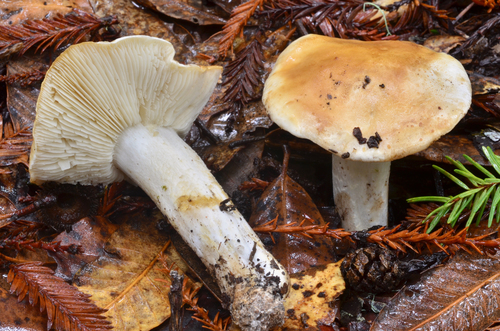
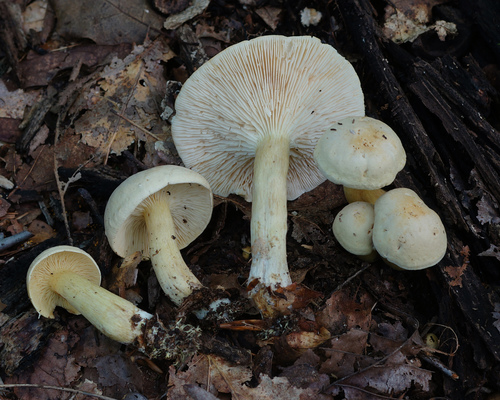
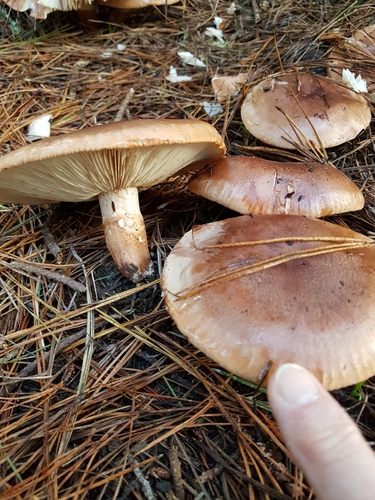
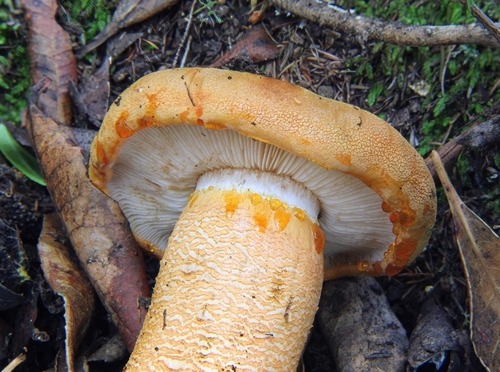
The cap of Tricholoma aurantium ranges from broadly convex to roughly flat, measuring 3–10 cm (1.2–3.9 in) wide, with an inward-rolled margin when young. Fresh specimens have a sticky or slimy cap surface, colored orange to dull reddish-orange, that bruises dark red when handled. The initially smooth cap surface can break apart into a network of fibrils and scales. Its gills are closely spaced, whitish, and develop brownish to reddish-brown stains as they mature. The gills are adnate to adnexed, and are sometimes notched. The stipe is often hollow, measures 4–8 cm (1.6–3.1 in) long by 1–2 cm (0.4–0.8 in) thick, and maintains roughly consistent width along its length or tapers slightly toward the base. The stipe surface is covered in dense orangish scales that end in a line near the top of the stipe, where the tissue is white. The flesh is white, has a mealy taste, does not change color when injured, and has an unpleasant farinaceous odor. The spore print is white. Spores are smooth, ellipsoid, inamyloid, and measure 5–6 by 3–4 μm. This mushroom is inedible because it is extremely unpalatable. Fruit bodies grow scattered, in groups, or in clusters on the ground, forming a mycorrhizal relationship with various conifer species. It is widely distributed across North America, and also occurs in Asia, specifically in India and Pakistan. Ectomycorrhizae of T. aurantium have been recorded with Pinus wallichiana and Abies pindrow in Pakistan, and with Abies alba (silver fir) in Italy.