About Tricholoma album (Schaeff.) P.Kumm.
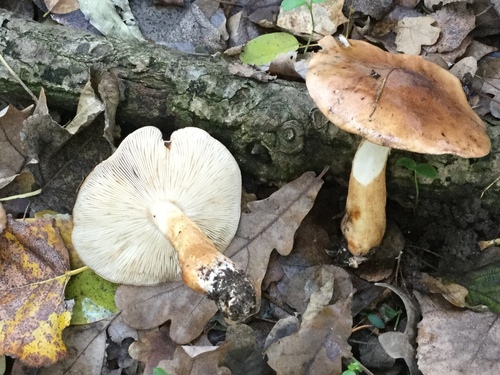
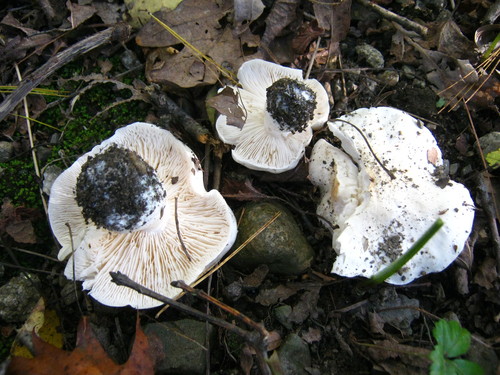
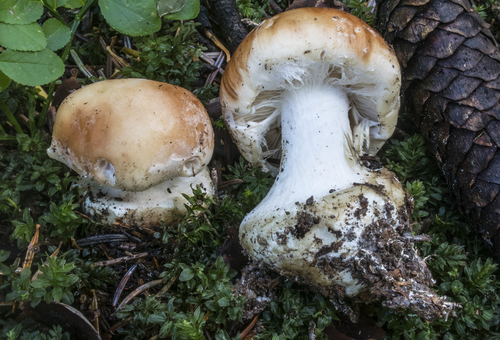
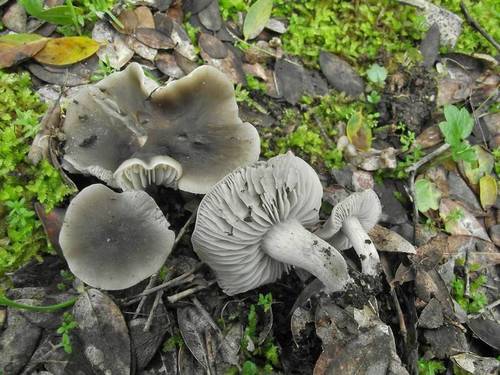
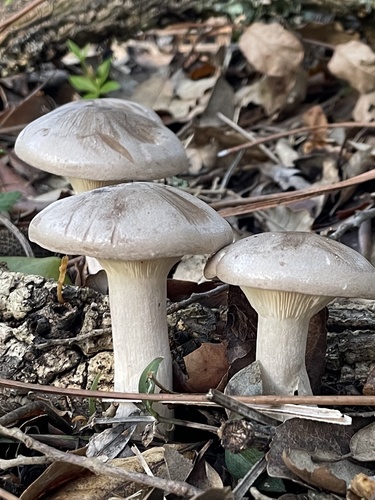
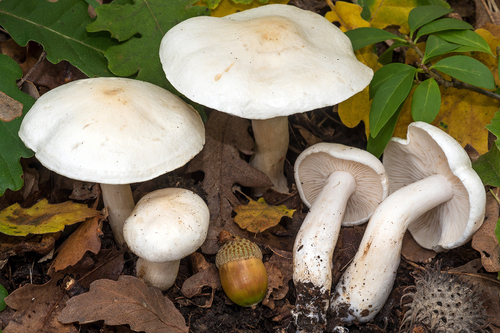
This species has the scientific name Tricholoma album (Schaeff.) P.Kumm. The cap of the fruit body ranges from 3 to 7.5 cm (1.2 to 3.0 in) wide. It is white with a pale yellow tinge, turning more yellow or ochre in the center as the fruit body ages. Caps are convex with a slight boss, starting broadly conical in shape with inrolled margins. The stipe is white to pale yellow or ochre-tinged, measuring 3–8.5 cm (1.2–3.3 in) tall and 0.8–1.5 cm wide. It has no ring, and the species also lacks a volva. The mushroom has a prominent unpleasant sweet smell that resembles a mix of honey and radishes, and has an acrid, disagreeable taste. Its thick gills are widely spaced and have finely serrated edges. The spore print is white; individual spores are oval or oblong, measuring 5–7 μm long by 3.5–5 μm wide. In ecology, Tricholoma album forms a mycorrhizal association with oak (Quercus) trees. Fruit bodies appear between August and December across Europe, where they can grow in sizeable fairy rings. Its confirmed presence in North America has not been documented; it was reported from India in 2010. Experiments have shown that inoculating blue pine (Pinus wallichiana) and deodar (Cedrus deodara) seedlings with this fungus increases the seedlings' height, as well as their shoot and root biomass.