About Trichoglossus euteles (Temminck, 1835)
Scientific Naming and Size
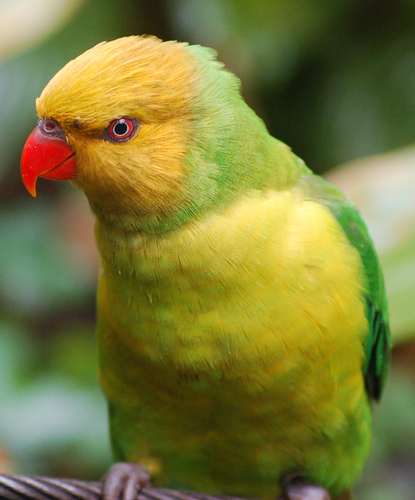
The olive-headed lorikeet, scientifically named Trichoglossus euteles (Temminck, 1835), is a primarily green parrot that reaches approximately 24 cm (9.5 in) in length.
Adult Head and Collar Morphology
As its common name suggests, it has an olive-colored head, which is marked off by a green collar.
Adult Soft Part Morphology
Its beak is orange-red, its irises are red, and its legs are grey.
Sexual Dimorphism
Male and female olive-headed lorikeets have identical external appearance.
Juvenile Morphology
Juveniles have a slightly greener head, a brown beak, and brown irises.
Endemism and Range Size
This species is endemic to the Lesser Sundas, giving it a restricted range.
Specific Distribution Locations
It is found on Adonara and Lembata, medium to large volcanic islands located off the eastern tip of Flores, in East Nusa Tenggara, Lesser Sundas, Indonesia.
Habitat and Elevation Range
The olive-headed lorikeet prefers rainforests and closed canopy forests, and occupies primary montane forest, secondary growth, and savanna woodland at elevations between roughly 1000 and 2300 m.
Wild Reproduction Knowledge
No information about the olive-headed lorikeet's reproduction in the wild is available.
Captive Reproduction Clutch and Incubation
In captive conditions, clutches contain three eggs measuring 24·5–25·3 mm × 22·5–23 mm, with an incubation period of 23 days.
Breeding Season
The breeding season of the olive-headed lorikeet runs from November to February.
Congeneric Longevity Record
One recorded sold Rainbow Lorikeet (Trichoglossus haematodus moluccanus) was reported to be 32 years old and still reproducing, though no further information about this individual was available.