About Triadica sebifera (L.) Small
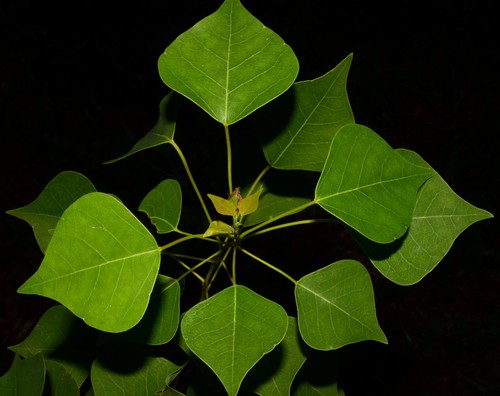
This tree, Triadica sebifera, is deciduous, with simple alternate leaves. Leaves are broad rhombic to ovate, with smooth edges; they are often heart-shaped and sometimes have an extended tip that resembles leaves of the bo tree, Ficus religiosa. Foliage is bright green above and slightly paler underneath, and turns bright yellow, orange, purple, and red in autumn. The tree is monoecious, meaning it produces both male and female flowers on the same individual. Waxy green foliage contrasts with clusters of greenish-yellow and white flowers that grow in terminal spike-like inflorescences up to 20 cm long. These pale light green flowers stand out prominently in spring. Solitary female (pistillate) flowers, located on short branches at the base of the spike, have a three-lobed ovary, three styles, and no petals. Male (staminate) flowers grow in clusters at the upper nodes of the inflorescence. Fruits are three-lobed, three-valved capsules that change color from green to brown-black as they mature. When capsule walls split away, they release three globose seeds, each about 12 mm in diameter and weighing approximately 0.15 g, that have a white, tallow-containing coating. Seeds usually remain hanging on the plant for several weeks. In North America, flowers typically mature from April to June, and fruit ripens from September to October. Triadica sebifera is native to China, likely originally from the Zhejiang area, and was documented in the Tang dynasty pharmacopoeia Xinxiu bencao. Cultivation of the tree may have started in the 7th century during the Tang dynasty in the Yangtze Delta region, from where it spread west and south across China. It reached the Philippines, Taiwan, northern Vietnam, and Hainan by the 17th century, and was introduced to Japan during the Edo period. By the 18th century, it spread to India, Caribbean islands, and the US states of South Carolina and Georgia via the East India Company. It can also be found growing in Sudan and southern France. While Benjamin Franklin is often credited with introducing the tree to the United States, after mentioning he obtained seeds in an October 1772 letter, it may actually have been introduced to South Carolina, Georgia, and Florida in early 1773 by John Bradby Blake, who had access to the seeds as early as late 1770 or early 1771. The tree has become naturalized along the Atlantic seaboard from North Carolina southward and across the entire Gulf Coast of the United States. It grows abundantly along ditchbanks and dikes, and thrives particularly well in open fields, abandoned farmland, and coastal prairie regions with disturbed ground, including areas like spoil banks, roadsides, and storm-damaged forests. It also grows along the edges of the Western Gulf coastal grasslands biome, and sometimes forms pure monoculture stands. It is listed as an invasive species in South Carolina. The white waxy aril covering the seeds (called stillingia tallow) is used to make soap. The inner oil of the seeds, called stillingia oil, is toxic, but has industrial uses in manufacturing cloth dressing and drying oils. The tree's nectar is non-toxic, and it has become a major honey plant for beekeepers. Honey produced from Triadica sebifera nectar is reportedly clear and high quality, and is produced in large quantities during June on the US Gulf Coast. In this region, beekeepers migrate their honey bee colonies to good Triadica sebifera stands near the gulf to produce this honey. The tree is fast-growing, valued as an ornamental, and provides good shade. It produces particularly striking autumn foliage when grown in areas with large seasonal temperature ranges, with leaves showing a wide variety of colors that rival the fall color of maples. It is not picky about soil type or drainage conditions, but will not grow in deep shade. It has fully naturalized across Japan, and is reasonably hardy. It should not be planted outside its native range due to its strong invasive tendencies.