About Treron sieboldii (Temminck, 1835)
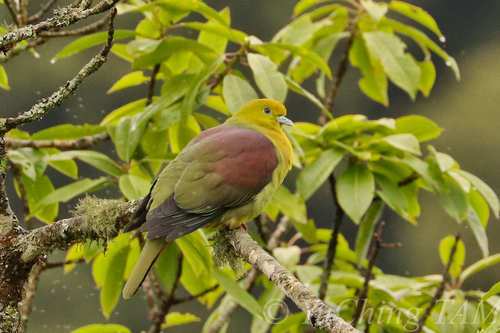
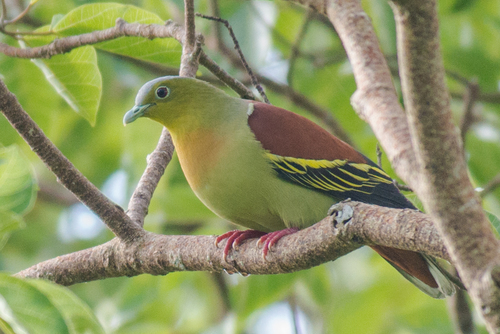
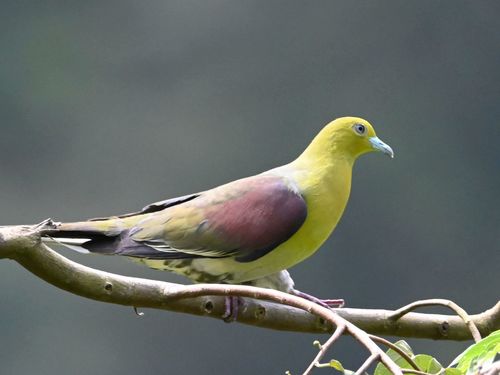
The white-bellied green pigeon, scientifically named Treron sieboldii (Temminck, 1835), is a medium-sized, compact pigeon that reaches a body length of over 14 inches (36 cm). Its tail measures 4 to 5 inches (10 to 13 cm) long, while its beak is less than 1 inch (2.5 cm) long. Males have a bright green head and chest, with olive-colored throats, necks, and wings. As the species name suggests, males have a white belly, undertail, and legs. Their beak is light bluish, with a maroon patch on the shoulders, vivid blue eye rings, and an iris that ranges from pink to violet. Their feet are red to violet. Females have a similar general appearance to males but are less colorful: they lack the maroon shoulder patch, and their breast is frosted green. White-bellied green pigeons are distributed across most of East Asia and Southeast Asia, including Japan, China, the Russian Far East, northern Thailand, Laos, and Vietnam. In Japan, their population is mainly found in Hokkaido and the Ryukyu Islands. In China, they occur in Hebei, southern Shaanxi, eastern Sichuan, Fujian, Guizhou, Guangxi, Hainan, Hong Kong, as well as on Taiwan and Orchid Island. This species is migratory, and winters in China. It is a forest-dwelling bird that lives in deciduous and mixed forests, and prefers primary forests. In Japan, it can be found in both lowland and mountain forests.