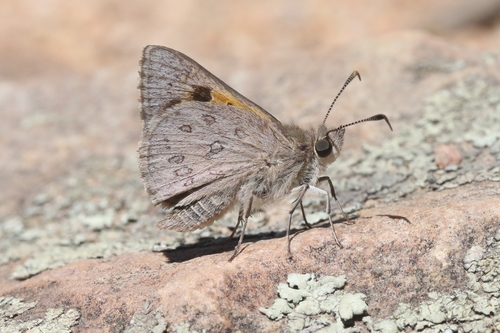
About Trapezites phigalioides Waterhouse, 1903
Adults of Trapezites phigalioides are brown on their upper side and grey on their lower side, with yellow or orange markings on the wings. The adult wingspan is approximately 30 mm (1.2 in). From the upper side, each forewing has three large yellow spots, a median yellow spot near the dorsum, a yellow streak along the dorsum, and a subapical band made of three pale yellow spots. Each upper-side hindwing has a single large band near its center. From the lower side, forewings have markings similar to those on the upper side, while hindwings have roughly 12 small brown circular markings. Adult males and females have a similar appearance. Eggs of this species are dome-shaped, white to cream in colour, with a diameter of approximately 1.3 mm (0.051 in) and up to 20 longitudinal ribs. Larvae are pinkish-brown or pinkish-grey with a dark brown head, and reach up to 26 mm (1.0 in) in length depending on their instar. Pupae are brown with dark brown spots, covered in a waxy grey powder, and measure approximately 20 mm (0.79 in) in length. In terms of behaviour and life cycle, adult Trapezites phigalioides fly quickly and close to the ground, and readily feed at flowers. Adult males perform hilltopping and establish territories within one meter of the ground. Adult females lay their eggs singly on the undersides of leaves of the species' host plant, wattle mat-rush (Lomandra filiformis). After hatching, larvae build a vertical shelter from silk and debris at the base of the host plant. They rest inside this shelter during the day and emerge to feed at night. Pupation takes place inside the larval shelter, with the larva's head oriented upwards. There is one generation per year, and adults primarily emerge in November and December.