About Trametes versicolor (L.) Lloyd
This species is scientifically known as Trametes versicolor (L.) Lloyd.
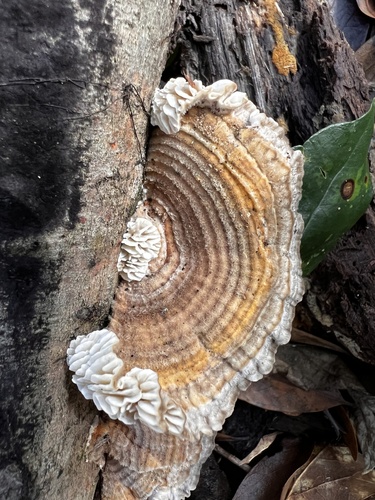
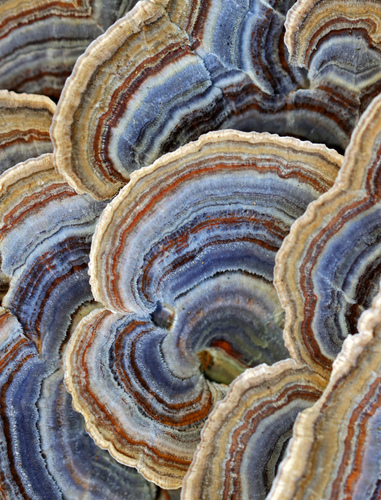
Its fruiting body is somewhat tongue-shaped, with no visible stalk. The tough flesh of the fruiting body is 1–3 millimetres (1⁄16–1⁄8 in) thick. The cap is flat, growing up to 10 centimetres (4 in) across. Caps are often triangular or round, with fine-haired zones colored rust-brown or darker brown, and sometimes have black zones. Underneath the fine-haired tomentum layer is a black layer, which sits above the whitish flesh. Older specimens can have zones with green algae growing on them. The upper surface of the cap typically shows concentric zones of different colors, with the margin always being the lightest. The pore surface on the underside of the cap has 3–5 pores per millimetre. Pores are whitish to light brown, originally round, and become twisted and labyrinthine as the mushroom ages.
Ecologically, T. versicolor commonly grows in overlapping tiled layers, in groups or rows, on logs and stumps of deciduous trees. It is a white rot fungus that degrades lignin from lignocellulosic materials like wood. This species may be eaten by caterpillars of the fungus moth Nemaxera betulinella, maggots of the Platypezid fly Polyporivora picta, and the fungus gnat Mycetophila luctuosa.
Trametes versicolor is considered too tough to eat as food, but can be prepared into products like teas and powders. It has been consumed for thousands of years in China under the name "Yunzhi" (Chinese: 云芝). It may be used in traditional Chinese medicine and other herbal practices. While polysaccharide-K extracted from this species is approved in Japan as an adjuvant therapy for cancer treatment, neither the extract nor mushroom preparations from Trametes versicolor are approved or used for any clinical condition in the United States. It is commonly marketed as a dietary supplement claimed to offer various health benefits, but there is not enough scientific evidence to confirm its safety or effectiveness. Product quality can also vary due to inconsistent processing and labeling.