About Tragopogon porrifolius subsp. eriospermus (Ten.) Greuter
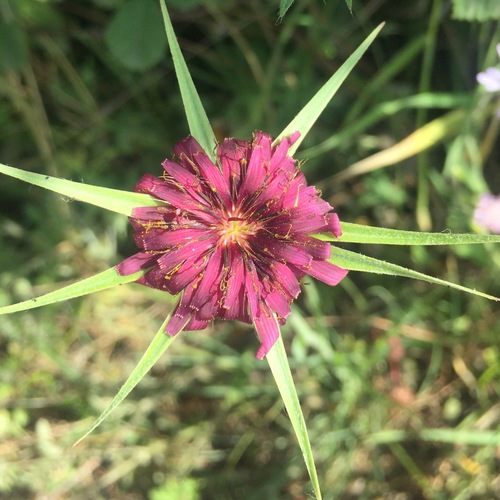
This is Tragopogon porrifolius subsp. eriospermus (Ten.) Greuter. The plant grows to 1.2 m (4 ft) in height. Like other Tragopogon species, its stem is mostly unbranched, and its leaves are somewhat grasslike, reaching up to 30 cm (12 in) long. Stems exude a milky juice when broken. Its taproots grow 15–30 cm (6–12 in) long and 2–5 cm (3⁄4–2 in) thick. It typically flowers from June to September, but in warmer regions such as California, it can bloom starting in April. The purple flower heads are 5–7.5 cm (2–3 in) across, and each is surrounded by 8–9 tapered bracts that are longer than the petals (properly called the ligules of the ray flowers). The flowers are hermaphroditic and pollinated by insects. The fruits are beaked achenes, which are rod-shaped with light ribs. They have hairs at one end that help them disperse via wind. Excluding the beak, the achenes are 10–17 mm long and 1–3 mm wide, while the beak can reach up to 55 mm in length. When fruits are fully developed, the fruit hairs form a fluffy ball that gives the plant its common name "goatsbeard". Tragopogon pratensis has similar flowers that are just smaller. Tragopogon porrifolius is a common biennial wildflower. It is native to southeast Europe, Mediterranean Turkey, and north Africa, but has been introduced to other areas including the British Isles (mainly central and southern England), other parts of northern Europe, North America, southern Africa, and Australia. In the United States, it now grows wild in almost every state, including Hawaii, with the only exception being the extreme south-east. The root and young shoots of T. porrifolius are edible after boiling. Freshly grown leaves can be eaten either cooked or raw. Historically, the plant was cultivated for food, and it is mentioned by classical authors such as Pliny the Elder. Cultivation of the plant began in 16th century France and Italy. In the United Kingdom, it was first grown for its flowers, then became a mildly popular vegetable in the 18th century, before declining in popularity. Today, the root is most commonly cultivated and eaten in France, Germany, Italy and Russia. In modern cultivation, it has mostly been replaced by Spanish salsify (Scorzonera hispanica). Cultivated varieties of T. porrifolius include 'White French', 'Gian French', 'Mammoth Sandwich Island', 'Improved Mammoth Sandwich Island', 'Blauetikett', and 'Lüthy', which generally have larger or better-shaped roots. To maintain cultivar purity, crops must be isolated by a distance of 500 ft (150 m). When grown for seed, T. porrifolius is harvested in the second season, from midsummer to early autumn, to select for bolt resistance. If the root is broken, which happens easily since it is hard to remove from soil without damage, it discolours and spoils quickly. A latex obtained from the root can be used as a chewing gum. While the whole plant is edible, the roots and leaves are most palatable when harvested before the flower stalk develops. Uncooked root has a mild flavour, compared to asparagus or oysters, which gives the plant its alternative common name oyster plant. The outer layers of the root can be scraped off, and the root can be dipped in cold water to preserve its colour. If roots are too tough to eat, they can be boiled with a pinch of baking soda and a change of water. Raw young roots can be grated for salads, while older roots are better cooked. Roots can be added to soups, stews or stir-fries. Salsify purée, made alone or with potato, is recommended as an accompaniment to fish. Flowering shoots can be used like asparagus, either raw or cooked. Flowers can be added to salads, and sprouted seeds can be used in salads or sandwiches. Raw salsify is 77% water, 19% carbohydrates, 3% protein, and contains negligible fat. In a 100 gram reference serving, raw salsify provides 82 calories, with moderate amounts of riboflavin, vitamin B6, vitamin C, manganese and phosphorus.