About Tradescantia zebrina Bosse
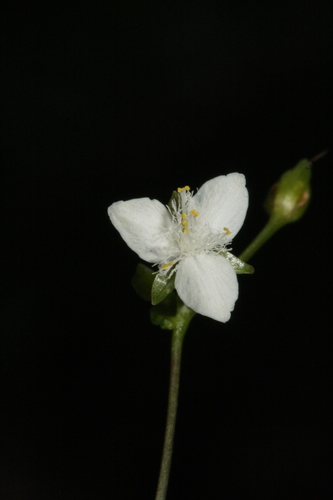
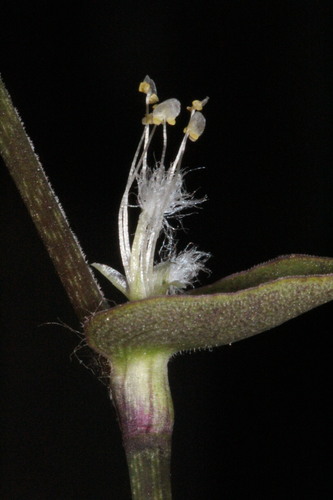
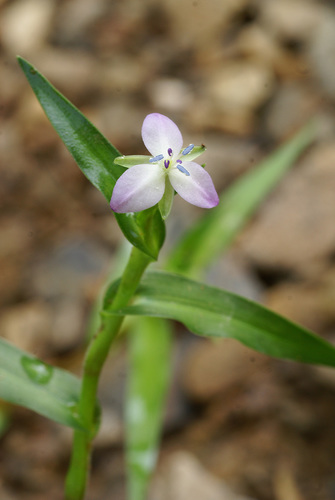
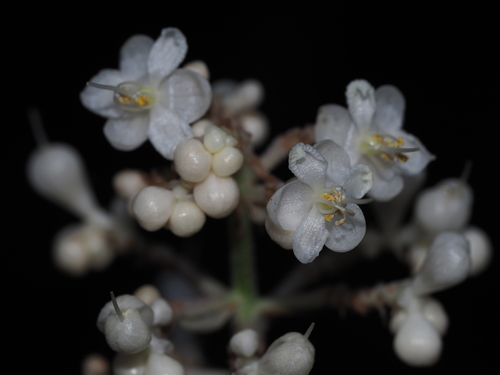
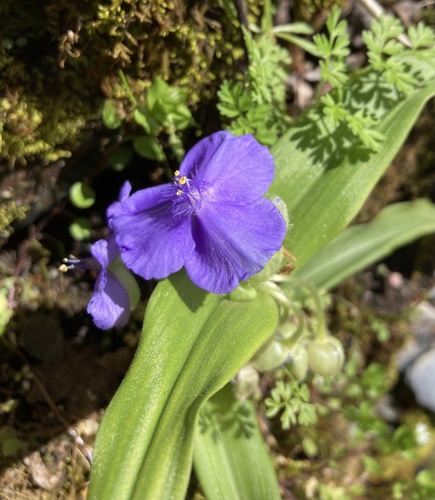
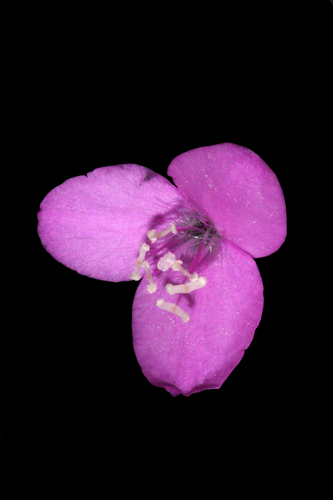
Tradescantia zebrina Bosse is best known for its attractive zebra-patterned foliage. Upper leaf surfaces show purple new growth and green older growth aligned parallel to the leaf’s central axis, with two broad silver-colored stripes along the outer edges. The entire lower leaf surface is a solid deep magenta; overall leaves are bluish-green, typically bearing two longitudinal stripes that are silvery on the upper surface and purple on the underside. Long-term chronic exposure to intense full sunlight causes the leaf’s variegation to fade, turning the entire leaf purple. Leaf sheaths are thin and translucent, measuring 8 to 12 mm long and 5 to 8 mm wide; they are longer at the opening, and are either glabrous or slightly hairy elsewhere. This species is a low-growing, slightly succulent, perennial herbaceous plant that very often forms dense mats or colonies, primarily through the natural development of taproots. Root primordia form at shoot nodes; when these are in permanent contact with water or a sufficiently moist substrate, roots will develop from the primordia within one day under favorable conditions. Shoots are either glabrous or hairy. Stalked, parallel-veined leaves are mostly ovate, 4 to 10 cm long and 1.5 to 3 cm wide. Leaves taper to a pointed tip and have a rounded to broad base. Upper leaf surfaces range from glabrous to mildly hairy, while lower leaf surfaces range from hairless to moderately hairy, with cilia present near the leaf base. Flower structure is generally similar to other Tradescantia species, with three pink petals and white sexual structures, but T. zebrina differs in its branching pattern: new buds for branches form below the leaf attachment, rather than above it. Flowers grow in clusters, held by two large foliage-like, narrow, ciliate bracts. The flowers are hermaphroditic, radially symmetrical, and trimerous. The three enlarged sepals are 2 to 3 mm long. The three petals, fused only at the base, are ovate with blunt tips, colored pink to purple, and measure 5 to 9 mm long. The six equal-sized stamens are covered in violet hairs. Three carpels form a superior, inferior ovary, and the plant produces capsule fruits that hold gray-brown seeds. Repeated contact or prolonged handling of this plant, especially exposure to its clear watery sap, may cause skin irritation; this characteristic is unique to T. zebrina among related Tradescantia types. Tradescantia zebrina is native to Mexico, Central America, and Colombia, and also occurs naturally on Caribbean islands. It has become naturalized in parts of Asia, Africa, Australia, South America, and various oceanic islands. It grows in thickets within wetlands and rainforests, often found growing on stones in both shady and open areas, or along river banks. It occurs at altitudes up to 2000 meters, though it grows most commonly at lower elevations. In cultivation, it is widely available and used as a houseplant and groundcover. When left undisturbed, it aggressively colonizes new areas, and can become an invasive species if not properly maintained. It is propagated by cuttings, and is easy to move or work with, as its runners cling lightly to the ground when grown as groundcover. It is not frost-resistant, but can be overwintered indoors in colder climates, and it is hardy in USDA hardiness zones 9, 10, and 11. The species, along with its cultivars 'Purpusii' and 'Quadricolor', has been awarded the Royal Horticultural Society's Award of Garden Merit.