About Trachycarpus fortunei (Hook.) H.Wendl.
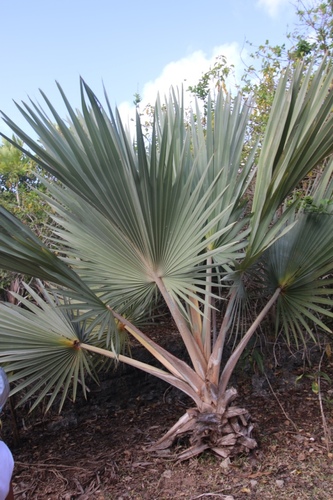
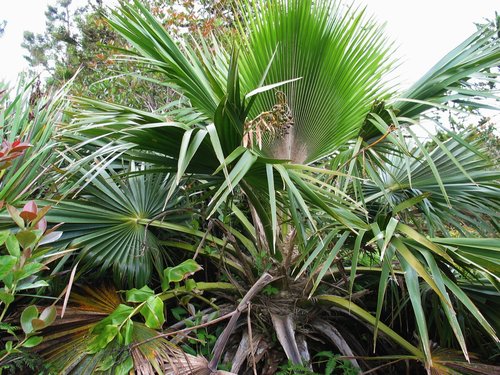
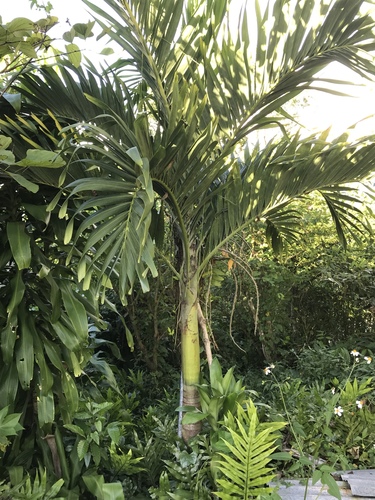
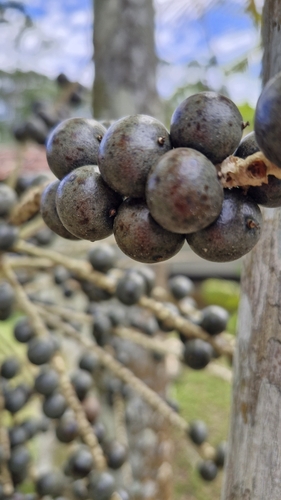
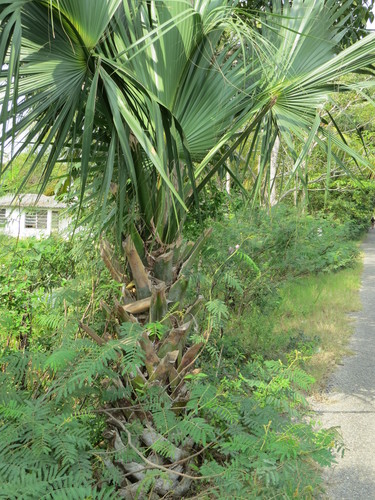
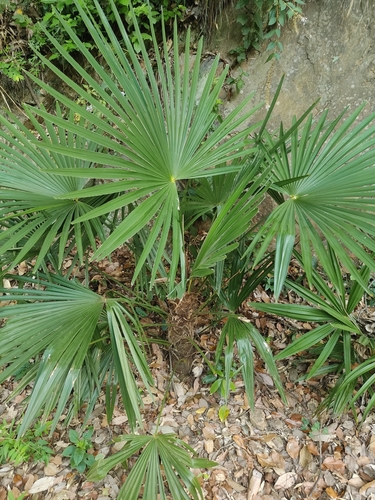
Trachycarpus fortunei (Hook.) H.Wendl. is a single-stemmed fan palm that grows 12–20 m (39–66 ft) tall. Its trunk reaches 15–30 cm (6–12 in) in diameter, with a very rough texture created by persistent leaf bases that clasp the stem in layers of coarse, dark grey-brown fibrous material. Its leaves have long petioles that are bare except for two rows of small spines, ending in a rounded fan made of many leaflets. Each full leaf measures 140–190 cm (5–6 ft) long, with the petiole making up 60–100 cm (2–3 ft) of that length, and individual leaflets can grow up to 90 cm (3 ft) long. This species is somewhat variable, especially in overall appearance: some specimens have leaf segments with straight tips, while others have drooping tips. It is dioecious, meaning male and female flowers grow on separate individual trees. Male flowers are yellow and female flowers are greenish; each flower is around 2–4 mm (0.1–0.2 in) across, and they are carried in large branched panicles up to 1 m (3 ft) long that bloom in spring. The fruit is a yellow to blue-black kidney-shaped (reniform) drupe 10–12 mm (0.4–0.5 in) long, which ripens in mid-autumn. This species has been cultivated in China and Japan for thousands of years, which makes tracing its original natural distribution difficult. It is believed to be native to central China from Hubei southwards, southern Japan's Kyushu, and extends south to northern Myanmar and northern India, growing at altitudes between 100–2,400 m (328–7,874 ft). Trachycarpus fortunei is one of the hardiest palm species. It tolerates both cool, moist summers and cold winters, as it grows at much higher altitudes than many other palm species, reaching up to 2,400 m (7,874 ft) in the mountains of southern China. It is not, however, the northernmost naturally occurring palm in the world: the European fan palm (Chamaerops humilis) grows farther north in the Mediterranean. Trachycarpus fortunei has been cultivated in China and Japan for thousands of years for its coarse but very strong leaf sheath fibre. This fibre is used to make rope, sacks, and other coarse cloth that requires high strength. The long history of widespread cultivation means the exact natural range of this species remains uncertain. It is cultivated as a full-trunked palm in gardens and parks across the world in warm temperate and subtropical climates. Its ability to tolerate cool summers and cold winters makes it popular with palm enthusiasts, landscape designers, and gardeners. It grows successfully in cool climates including the United Kingdom, France, Belgium, the Netherlands, coastal Poland, and southern and western Germany. In the UK, it has received the Royal Horticultural Society's Award of Garden Merit. The tallest cultivated specimen on record stands 16.1 m (53 ft) tall in a park at Uhart-Mixe, Pyrénées-Atlantiques, France. Due to its widespread use as an ornamental plant, this palm has become naturalized in southern regions of Switzerland, where it is considered a problematic invasive species. In North America, mature specimens grow naturally in coastal areas of the Pacific Northwest, the Upper South, and Mid-Atlantic states. They grow along the West Coast from California north to coastal southwestern British Columbia, and along the East Coast from northern Florida to coastal Connecticut. Mature plants are commonly reported to tolerate minimum temperatures between −15 to −20 °C (5 to −4 °F). Young plants are less hardy, and can be damaged by temperatures as high as −8 °C (18 °F). A well-documented specimen in Plovdiv, Bulgaria has survived a recorded low temperature of -27.5 °C. The cultivar group Trachycarpus fortunei 'Wagnerianus' is a small-leafed semi-dwarf variant selected for cultivation in China and Japan. It rarely grows taller than 5 m (16 ft), and its leaflets are less than 45 cm (1 ft 6 in) long. Its short stature and small leaves give it greater tolerance to wind exposure. It has often been listed as the separate species Trachycarpus wagnerianus in popular horticultural works, but is now classified as part of Trachycarpus fortunei.