About Trachelospermum asiaticum (Siebold & Zucc.) Nakai
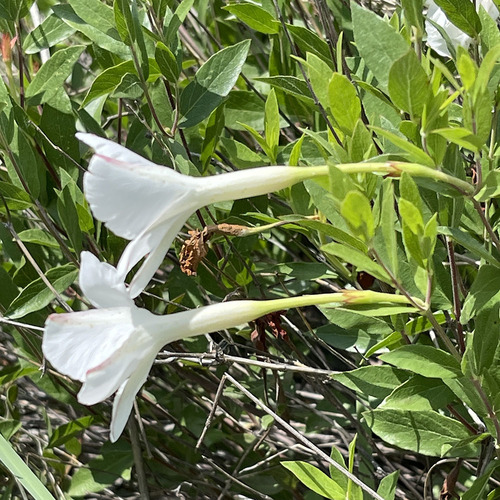
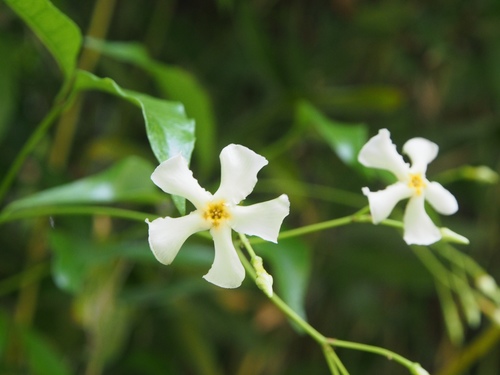
Trachelospermum asiaticum (Siebold & Zucc.) Nakai is a woody evergreen climber that can grow up to 6 m (20 ft) tall. It bears glossy leathery leaves and strongly scented cream-coloured flowers in summer. When cut, its stems exude a milky white latex. Its leaves are simple, opposite, and persistent; they grow on a 2–10 mm petiole, with an elliptic to narrowly ovate blade 2–10 cm long by 1–5 cm wide, with a membranous texture. The glossy green leaves develop a brown-orange tinge that stains reddish during winter. This is the hardiest species in the Trachelospermum genus, and can be cultivated in temperate regions when grown against a sheltered wall or fence. It is known to spread very rapidly and can quickly take over large areas. Trachelospermum asiaticum is native to China, India, Japan, Korea, Indo-China, and Malaysia. It grows naturally in mountain forests and scrub, often growing attached to trees. It is quite similar in cultivation to the related false jasmine Trachelospermum jasminoides, but T. asiaticum produces flowers with a slightly smaller yellow or cream central area. It grows faster during its early years than T. jasminoides. It can be grown as an evergreen ornamental ground cover, or grown as a liana planted along a wall or trellis, and tolerates either semi-shade or full sun exposure. It gives off an intense fragrance during its summer flowering period. It can withstand brief frosts as cold as -15 °C. This species has gained the Royal Horticultural Society's Award of Garden Merit, and several cultivars are available, including multiple varieties with different variegation patterns and dwarf growing forms.