About Toxicodendron diversilobum (Torr. & A.Gray) Greene
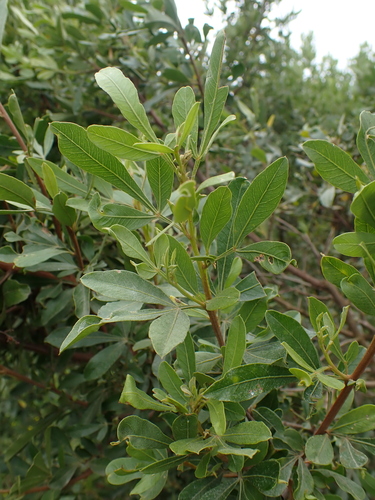
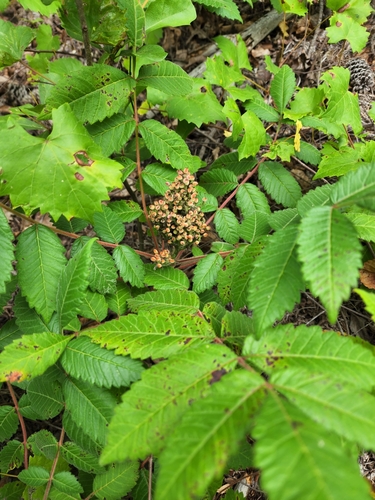
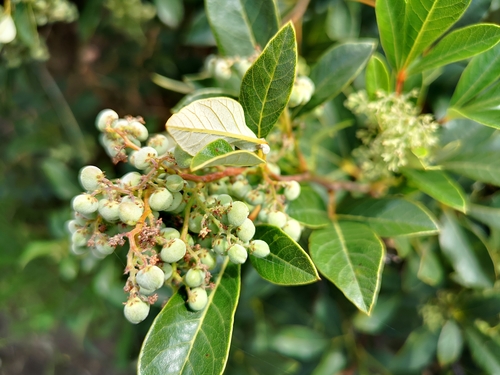
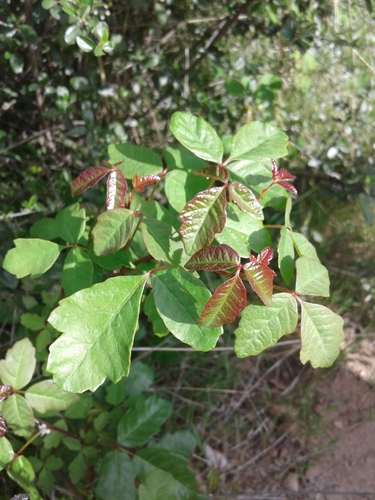
Toxicodendron diversilobum (Torr. & A.Gray) Greene is extremely variable in both growth habit and leaf appearance. In open sunlight it grows as a dense shrub 0.5 to 4 metres (1+1⁄2 to 13 feet) tall; as a treelike vine it reaches 3 to 9 m (10 to 30 ft) in height, and may grow over 30 m (100 ft) long with an 8 to 20 centimetres (3+1⁄4 to 7+3⁄4 inches) trunk. In shaded areas it forms dense thickets, and it can also take any intermediate growth form. It reproduces both via spreading rhizomes and by seeds. This species is winter deciduous: once cold weather arrives, stems become leafless, and only hold occasional clusters of mature fruit. Leafless stems can sometimes be identified by rare black marks left when milky sap oozed out and dried. Its leaves are divided into three leaflets, rarely 5, 7, or 9, each 3.5 to 10 cm (1+1⁄2 to 4 in) long, with edges that are scalloped, toothed, or lobed. The leaves generally resemble the lobed leaves of true oaks, but tend to be more glossy. The leaves change color through the growing season: they are typically bronze when they first unfold between February and March, bright green in spring, yellow-green to reddish in summer, and bright red or pink from late July through October. White flowers develop in spring, from March to June. If pollinated, the flowers produce greenish-white or tan drupes. Botanist John Howell observed that the plant’s toxicity hides its aesthetic qualities: In spring, ivory flowers bloom on sunny hills or in sheltered glades; in summer, its fine green leaves provide a refreshing contrast to dry, tawny grassland; in autumn, its colors blaze more brilliantly than any other native plant. But one major flaw, its poisonous sap, cancels out every other virtue, leaving this attractive shrub the most disparaged plant in its native region. Toxicodendron diversilobum is distributed across California, the Baja California Peninsula, Nevada, Oregon, Washington, and British Columbia; notably, Los Angeles was built on the site of a village named Yaangna or iyáanga’, which translates to "poison oak place". The related T. pubescens, eastern poison oak, is native to the Southeastern United States. T. diversilobum hybridizes with T. rydbergii, western poison ivy, in the Columbia River Gorge area. This species is common across a wide range of habitats, from moist riparian zones to dry chaparral. It grows well in conditions from shady and dappled light to full direct sunlight, at elevations below 1,500 m (5,000 ft). Climbing vining forms can grow up the trunks of large shrubs and trees to reach the tree canopy. Sometimes this growth kills the supporting plant by smothering it or breaking it. The plant is often found in chaparral, woodlands, coastal sage scrub, grasslands, and oak woodlands, as well as Douglas-fir (Pseudotsuga menzesii), hemlock–Sitka spruce, Sequoia sempervirens (coast redwood), Pinus ponderosa (ponderosa pine), and mixed evergreen forests. In ecological terms, black-tailed deer, mule deer, California ground squirrels, western gray squirrels, and other native wildlife eat the plant’s leaves. Its leaves are rich in phosphorus, calcium, and sulfur. Birds eat the berries and use the plant’s structure for shelter. Neither native animals, nor horses, livestock, or dogs have reactions to urushiol, the plant’s irritating oil. Because humans commonly have allergic reactions to this plant, it is almost always removed from gardens and public landscaped areas. It can act as a weed in agricultural fields, orchards, and vineyards. It is typically removed by pruning, herbicides, digging out, or a combination of these methods. Poison oak is susceptible to infection by the pathogen Phytophthora ramorum. Toxicodendron diversilobum leaves and twigs produce a surface oil called urushiol, which triggers an allergic reaction. This oil causes contact dermatitis, an immune-mediated skin inflammation, in four out of five humans. Most, if not all, people will become sensitized to urushiol over time with repeated or more concentrated exposure. The active components of urushiol have been identified as unsaturated congeners of 3-heptadecylcatechol, with up to three double bonds in an unbranched C17 side chain. In poison ivy, these components are unique for containing a -CH2CH2- group in an unbranched alkyl side chain. Californian Native Americans used this plant for several purposes. They used stems and shoots to make baskets, sap to treat ringworm, and applied a poultice of fresh leaves to rattlesnake bites. Juice or soot was used as a black dye for sections of sedge baskets, for tattoos, and for darkening skin. Some native groups took an infusion of dried roots, or ate buds in spring, to gain immunity to the plant’s poison. The Chumash people used T. diversilobum sap to remove warts, corns, and calluses; to cauterize sores; and to stop bleeding. They drank a decoction made from the roots to treat dysentery. In cultivation, Toxicodendron diversilobum can be planted as a carefully sited component in wildlife gardens, habitat gardens, and natural landscaping. It is also used in habitat restoration projects. It can act as an early stage succession plant in areas where woodlands have been burned or cleared, serving as a nurse plant for other species.