About Torreya taxifolia Arn.
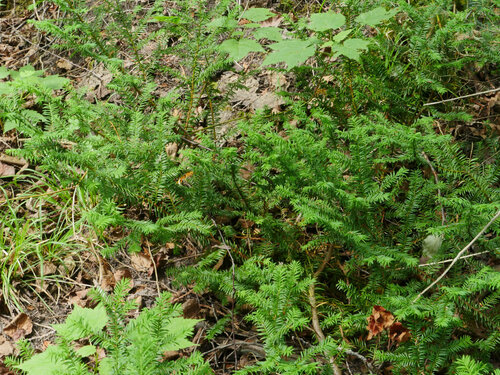
Torreya taxifolia Arn. is an evergreen tree. Mature wild specimens historically reached 18 m (59 ft) tall with an 80 cm (31 in) diameter trunk, though typical sizes were 9–12 m (30–39 ft) tall and 30–50 cm (12–20 in) in diameter. Almost all current wild stands are made up of immature trees shorter than 3 m (9.8 ft).
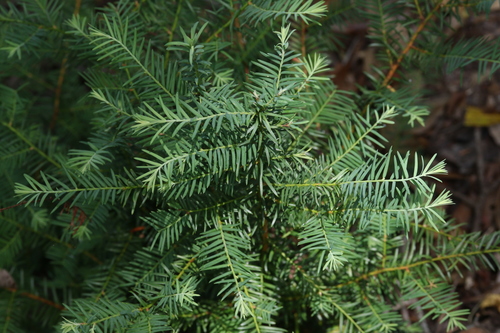
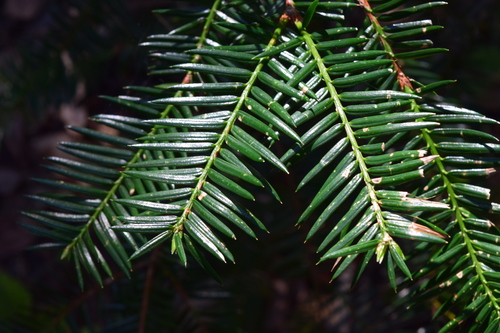
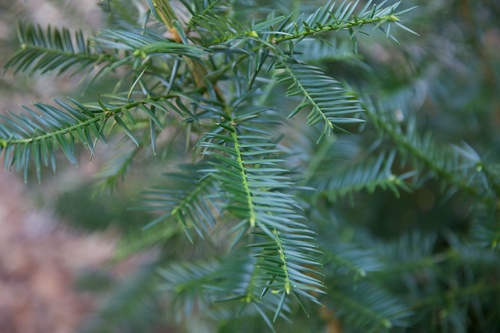
Its overall crown is open and conical, with whorled spreading to slightly drooping branches. Bark on two-year-old branches is yellowish-green, yellowish-brown, or grey. On mature trees, bark is only about 1.3 cm (0.5 in) thick and divided irregularly by shallow fissures. The stiff, needle-like leaves are sharp to the touch, arranged in two ranks along branches, with size varying by sunlight access and tree health. Leaves are glossy green on the upper surface and light green below, with a very slightly sunken grayish stripe of stomata on either side of the midrib on the underside, and are slightly round in transverse profile on the topside. Crushed leaves emit an unpleasant, strongly pungent, resinous odor.
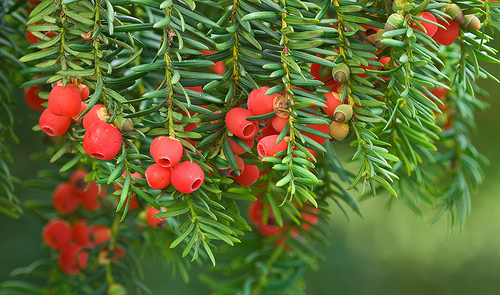
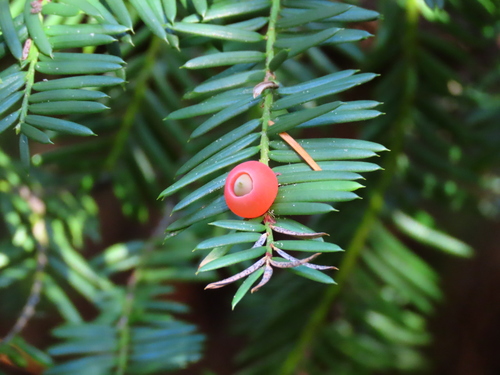
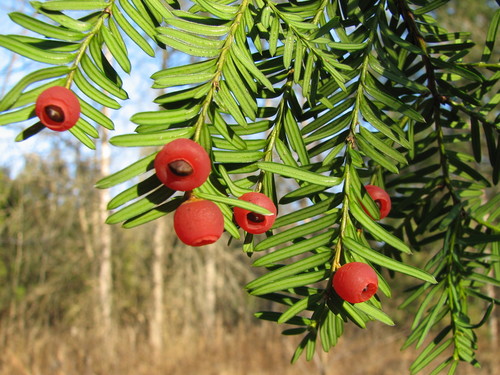
Genus Torreya is subdioecious: individual plants typically produce separate male or female cones, but may also have branches bearing cones of the opposite sex. Male cones grow in the axils of the previous year's needles, while female cones grow in the axils of the current year's needles, and do not ripen until their second year. Male pollen cones resemble those of common yew, but are much larger, with imbricated scale bracts at their base. They are 5–7 mm long, grouped in lines along the underside of a shoot. Young female cones are more angular than male cones, and grow in groups of two to five near the tip of a branchlet. Tiny at first, they mature over about 18 months into a drupe-like structure that holds a single large nut-like seed. The seed is surrounded by a fleshy covering called an aril; the whole structure is 2.5–3.5 cm (0.98–1.38 in) long, about the size of nutmeg. The aril is green when young, becomes purple-streaked as it matures, and turns fully orange or purple by late fall. Unlike true yews, where the aril forms a cup around the seed, the aril of Torreya taxifolia completely encloses the seed, leaving only a tiny hole at the end. When the aril is removed, the seed strongly resembles a large acorn.
Torreya is an ancient genus at least 160 million years old. Fossil evidence shows the genus was widely distributed across the Northern Hemisphere from the Jurassic period through the Pliocene. As part of the Arcto-Tertiary Geoflora, the genus was forced southward during cooling of the Plio-Pleistocene epochs. In western North America, small isolated populations survived in coastal California mountains and the western slope of the Sierra Nevada, which remain the native range of Torreya californica. Glacial advance was much greater on the eastern side of North America, and no far-southern mountains provided suitable refuge for the genus. The only location that allowed Torreya to survive through the coldest Pleistocene periods and the subsequent warmer Holocene was ravines along the east shore of the Apalachicola River in northern Florida. Today, this area is the entire native range of Torreya taxifolia, making it a paleoendemic glacial relict. All U.S. Fish and Wildlife Service official documents for this species classify it as a glacial relict. The 1984 official endangered listing noted that the Apalachicola River system acted as a refugium for species moving south during recent glaciations, and cool moist conditions persisted on its bluffs and ravines after glaciers retreated, even as surrounding areas became drier and warmer. The 1986 initial recovery plan added that the genus now has four or five species native to Florida and Georgia, California, China, and Japan; its current disjunct distribution, paired with fossil evidence, matches the pattern of other genera that were widespread during the Tertiary Period, and had their ranges reduced by Quaternary climatic changes. The 2020 updated recovery plan speculates that T. taxifolia once ranged as far north as North Carolina, and was forced south by advancing glaciers, then became isolated in small areas of the southeastern United States after glaciers retreated. Fossil records of Torreya are limited to seeds, leaves, and secondary wood from the Upper Cretaceous, and confirm the genus had a much wider distribution in the past than it does today. A fossil named T. antigua, which shares traits with both T. taxifolia and T. californica, was described from Mid-Cretaceous deposits in North Carolina, and has also been found near MacBride's Ford, Georgia. Torreya pollen cannot generally be distinguished from pollen of other Taxaceae genera, or from genera in Taxodiaceae and Cupressaceae, so confirming the genus's past presence in locations without macrofossils is difficult. Even so, the strongly disjunct distribution of Torreya sister species across the Northern Hemisphere, paired with macrofossil evidence of the genus growing at northerly latitudes during warm periods of the Tertiary, confirms that the eastern North American Torreya species occupied more northerly habitats for millions of years before Quaternary glaciation.
The relict status of this conifer's native range has been recognized for over a century. A 1884 U.S. Commissioner of Agriculture Annual Report, which lists "Stinking Yew" and "Savin" as common names for the species, noted that Torreya is a relic of a past epoch that likely once had a much wider range. Botanist Henry C. Cowles visited the area in 1904, and observed that wild torreya grew alongside a large group of northern mesophytic plants, leading to the conclusion that Torreya is a distinctly northern mesophytic plant, best grouped with the beech-maple-hemlock associations of northern mesophytic woodlands.
In its native range, Torreya taxifolia grows along limestone bluffs on the eastern shore of the Apalachicola River, in a warm humid climate that occasionally sees winter temperatures drop below freezing from northern cold waves. It grows mostly in shaded wooded ravines and steep north-facing slopes, under a canopy of other mesic species in rich soils, as part of the Southern Coastal Plain Mesic Slope Forest ecological system. Common canopy trees include American beech (Fagus grandifolia), tulip tree (Liriodendron tulipifera), Florida maple (Acer floridanum), sweetgum (Liquidambar styraciflua), white oak (Quercus alba), and occasionally loblolly pine (Pinus taeda) or spruce pine (Pinus glabra). Vines such as Smilax species and crossvine (Bignonia capreolata) are often abundant in these woods. Another rare conifer, Florida yew (Taxus floridana), occasionally grows alongside T. taxifolia. These local ravines are called steepheads, and have nearly permanent seeps. The combination of subcanopy shade, preference for north-facing slopes, and permanent seeps suggests that T. taxifolia has already retreated to the coolest available subhabitats within this glacial refugium to survive modern summer heat extremes.
Because T. taxifolia has such a small confined native range, the habitat associations seen there do not fully capture the species' true habitat preferences in the current warming Holocene. The citizen advocacy group Torreya Guardians hosts a webpage titled "Historic Groves of Torreya Trees: Long-Term Experiments in Assisted Migration," which categorizes groves as naturalized groves, mature trees producing seeds, and mature trees not producing seeds. As of 2022, 14 historic grove sites are listed with descriptions, maps, and links, alongside six academic papers that discuss the value of these groves for evaluating assisted migration as the climate warms. The northernmost grove of horticulturally planted T. taxifolia that produces seeds is located in Cleveland, Ohio.
The extremely small size of the species' native range has always been a core concern for its future. In 1875, Harvard botanist Asa Gray named restricted range and human overuse as the primary threats, though he noted that abundant seedlings and the species' ability to resprout new stems from existing rootstock offered some protection against extinction, so long as the bluffs were not cleared. In 1885, A. W. Chapman identified overharvesting of the extremely durable wood for posts, shingles, and other construction as the main threat, noting that large trees were abundant enough in the 1830s to be sawn into planks for building the village of Aspalaga Landing. Into the early 1900s, human activity remained the only identified threat, while the species' relict status continued to draw scientific interest. In a 1904 conference contribution, Henry C. Cowles wrote that the mesophytic plant association found with T. taxifolia is abundant far to the north, and reaches its southern limit here, meaning T. taxifolia is a northern mesophytic plant left stranded in Florida, having failed to retreat northward after the last Pleistocene ice retreat. In 2018, the inherent risk of having a small endemic range was demonstrated: Atlanta Botanical Garden had just transplanted 700 T. taxifolia trees to Torreya State Park, Florida, with E. O. Wilson in attendance, when Hurricane Michael destroyed the entire planted stand by felling hardwoods onto the young saplings.
After T. taxifolia was listed as federally endangered in 1984, the first 1986 recovery plan listed multiple fungal species associated with diseases affecting the species, but did not identify any single pathogen as the sole or dominant cause of the sudden extreme die-off of almost all reproductively mature stems. Fusarium was included on the list, linked to root rot rather than needle necrosis. The plan suggested that pathogens were likely the proximate causes of decline, with environmental factors as the ultimate cause: the multiple soil-dwelling opportunistic fungi found on dying trees indicated that fungal infections were a symptom of an underlying problem. The plan noted that decline may ultimately stem from environmental stressors including forest habitat alteration, changes to overstory vegetation above the ravines, altered water seepage into ravines, or drought. Proximate causes include a range of fungal infections that cause stem cankers, stem and leaf blight, and other issues. This decline has affected all wild Florida torreya, and possibly all cultivated specimens. The plan framed habitat deterioration in the context of long-term climate change, noting that the species' restricted range makes it vulnerable to both human habitat disturbance and natural climate change. The decline has been so severe that almost no seed-bearing wild trees remain, making natural recovery through sexual reproduction impossible. The plan noted that even small human habitat alterations could seriously harm the species, and that the current environment of the Apalachicola bluffs and ravines may only be marginally suitable. The species may be confined to this area simply because it failed to migrate northward after the end of the Pleistocene. The plan also noted that torreya requires steady moisture from seepage and summer shade, and identified logging, upland pine forest alteration above ravines, and possible microclimate changes from the 1956 completion of Jim Woodruff Dam as potential human-caused habitat changes that harmed the species.
Mark W. Schwartz was the scientist who led assessment of Jim Woodruff Dam's impact. First, he partnered with Rob Nicholson of Harvard's Arnold Arboretum to complete the first objective of the federal recovery plan: collecting cuttings from remaining wild specimens to create a genetically diverse collection of healthy mature trees in cultivation, to preserve the gene pool for future reintroduction to native habitat when conditions become suitable. More than 2,000 branchlets were collected from the wild, rooted, and held at Arnold Arboretum and other institutions. Schwartz then partnered with Sharon M Hermann to conduct a field survey published in 1993, documenting the continuing population decline of T. taxifolia. In 1995, Schwartz, Hermann, and Cristoph S. Vogel published results of their assessment of eight possible hypotheses for the decline: three biotic agent hypotheses and five abiotic trigger hypotheses. The abiotic triggers assessed were water stress, microclimatic warming, regional warming, hydrologic change, and fire suppression. The team documented that both regional drought and dam construction coincided with the start of the decline, but concluded that neither could explain the scale of the die-off, noting that the argument for any single one of these environmental factors causing the decline is very weak. They did acknowledge that if T. taxifolia is limited by warm temperatures, even a small temperature increase could make it susceptible to native pathogens, making it an early casualty of global warming. Because the team focused on ecology rather than pathology, their assessment of biotic agent hypotheses relied on existing published pathology research. They ruled out introduced pathogens, pathogen vectors such as deer antler rubbing, and fungal pathogens as a temporary epiphenomenon, but acknowledged that most catastrophic plant declines involve exotic pathogens, so an unidentified pathogen could ultimately be confirmed as the cause.
Schwartz assembled a new team to model future extinction timing for wild T. taxifolia, and their 2001 paper added field context for the initial die-off and the species' response. They noted that the 1950s population crash killed all wild adult trees, leaving only nonreproductive juvenile trees alive today. Unlike American chestnut, where adult trees died back to the ground but survived as individuals, adult T. taxifolia died entirely, and current living trees are not linked to dead stumps, meaning they existed as seeds or seedlings at the time of the decline. Today, most wild T. taxifolia grow as small trees with multiple stems sprouting from a single main root axis; these secondary stems (epicormic or coppice shoots, or aerial suckers) sprout from the base of the main stem or the root collar. The team summarized published pathogen research, concluding that despite repeated attempts, no disease-causing agent has been isolated, and no other cause of decline has been documented. They also noted that demographic data shows no sign of recovery: no seed production has been observed in the wild for at least 25 years, and no anecdotal reports of wild seed production exist for that period.
Before the mid-20th century sudden extreme die-off, the only regular conservation suggestion was to protect Florida torreya from overharvesting. By the time the die-off began, a state park already existed in the core of the species' range. Torreya State Park was established in the 1930s, and employed Civilian Conservation Corps workers during the Great Depression. Though named for the endemic torreya, the site was selected primarily for historic preservation: it holds six Confederate gun pits on a high bluff along the Apalachicola River, and an antebellum cotton warehouse near a dock. In 1935, the dilapidated Jason Gregory plantation manor was disassembled, moved from the west side of the river to the park on the east side, and restored as a park centerpiece. From 1982 to 1984, The Nature Conservancy acquired more than 6,000 acres to conserve and restore steephead ravines and uplands south of Torreya State Park, called the Apalachicola Bluffs and Ravines Preserve. Both properties suffered severe habitat damage in October 2018, when Category 5 Hurricane Michael made landfall.
One of the recovery actions in the federal recovery plan is to reestablish T. taxifolia in its native habitat. Because all remaining wild plants are young stems that die back and resprout from the same rootstock, conservation work focused on reestablishment first tests habitat improvement practices to help new plantings survive. In 2002, an experimental planting used potted seedlings grown from cuttings collected 12 years earlier to test whether treatments would improve survival. None of the tested treatments (fungicide, fertilizer, lime, or combinations) worked; two-thirds of the 60 planted seedlings died in their first year. The 2020 recovery plan update reported that a new experiment was started in 2011 in native forest habitat. In this experiment, wild resprouted stems were caged to prevent herbivory and antler rubbing damage, then assigned to different treatments: untreated control, mulch application, lime application, experimental canopy opening to increase morning sunlight, and a combination of all four treatments. An additional 100 wild torreyas were located and caged in 2012. No results had been reported to the federal agency when the update was published. After Hurricane Michael opened large areas of canopy in October 2018, monitoring began immediately after debris was cleared from crushed existing stems. Post-hurricane disaster funding was awarded to TorreyaKeepers, a new local citizen group affiliated with the Florida Native Plants Society. This group successfully secured permission from private landowners in the native range to document additional wild specimens, and collect cuttings that Atlanta Botanical Garden rooted and added to their living collection. This work safeguarded more genetic diversity than had previously been collected.
Despite ongoing efforts to improve or restore native range habitat after Hurricane Michael, the chance of restoring the species to viability in its native range has long been considered low. Starting in the late 1950s, a sharp decline in the health and reproductive capacity of native stands was observed. Since that time, all full-sized mature trees have died, and seed production is extremely rare in the wild. Where 60-foot trees once grew, almost no existing individuals are over 10 feet tall. While research into the cause of decline continues, in situ preservation is considered problematic, so current management includes propagating rooted cuttings from documented wild stands to grow in ex situ collections. Because wild seed production is so rare, vegetative propagation is the only way to preserve documented wild germplasm for study, distribution, and future reintroduction. Thus, ex situ genetic safeguarding is widely recognized as a necessity.