About Torreya nucifera (L.) Siebold & Zucc.
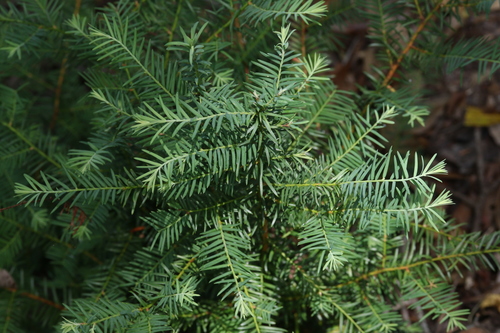
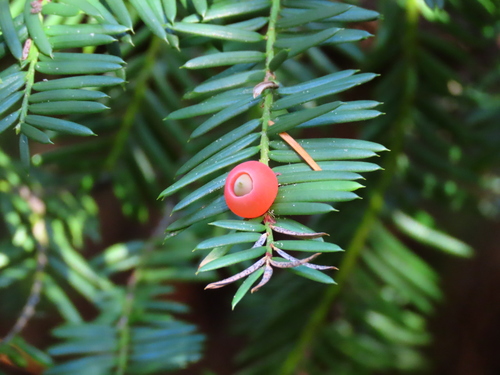
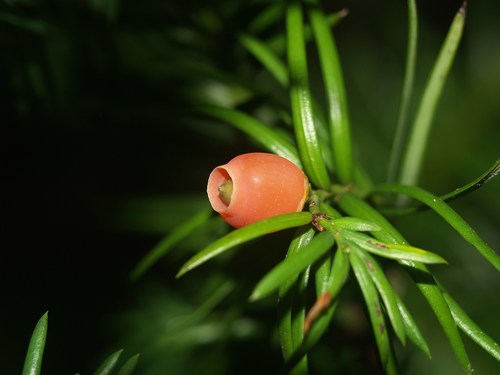
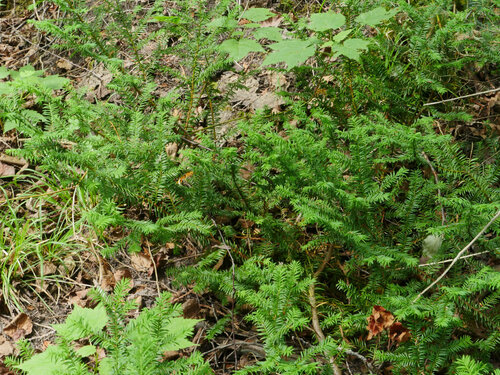
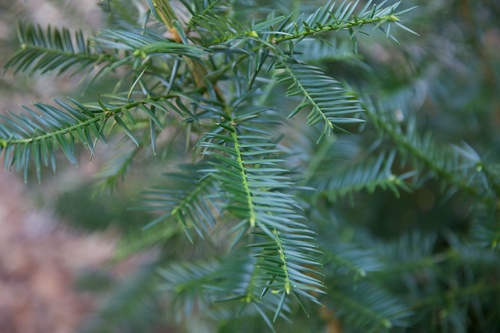
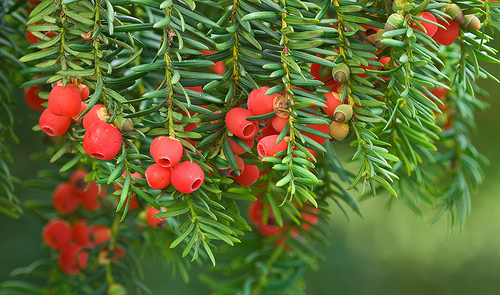
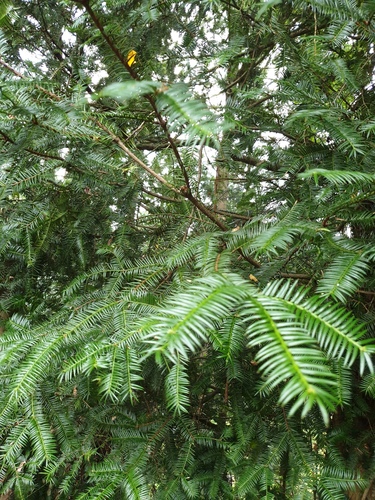
Torreya nucifera (L.) Siebold & Zucc. is a tree that grows 15 to 25 meters tall, with a trunk that can reach up to 1.5 meters in diameter. It has evergreen, needle-like leaves that measure 2 to 3 centimeters long and 3 millimeters broad. Each leaf has a sharply spined tip and two whitish stomatal bands on its underside. Leaves are arranged spirally along the stem, but are twisted at the base to lie horizontally on either side of the stem. This species is subdioecious: individual trees produce mostly male or mostly female cones, but almost always have at least some cones of the opposite sex present. Male cones are globular, 5 to 6 millimeters in diameter, and grow in a double row along the underside of shoots. Female cones are borne in clusters of 3 to 8, and mature over 18 to 20 months to form a single seed surrounded by a fleshy layer, 2 centimeters long and 1.5 centimeters broad. In a 1916 botanical survey of Japanese conifers published by Ernest Henry Wilson, Wilson recorded finding kaya (the common name for this species) in both broad-leafed and coniferous stands, in nearly every wood and forest, ranging from Yakushima to Tokyo. The most abundant location he noted was on Mount Takao, southwest of Tokyo, where it grew plentifully on steep shale slopes alongside Abies firma. The wood of Torreya nucifera is highly valued for making Go boards and Shogi boards, prized for its attractive yellow-gold color, fine and uniform ring texture, and the distinct quality of sound produced when a stone is placed on its surface. The species is protected in Japan because it has become scarce after centuries of overharvesting. Thick Go boards require harvesting ancient kaya trees, which makes finished boards extremely expensive; the highest quality boards can cost more than $19,000. Shin-kaya, meaning "new kaya" in Japanese, is an imitation material usually made from Alaskan, Tibetan, or Siberian white spruce, and has become somewhat popular for lower-cost equipment due to the scarcity of natural kaya. Go bowls can also be made from kaya wood, though this is less common. In Japanese esoteric Buddhist sects such as Shingon, the tree's leaves and extracted oil have ritual uses. The leaves are used to represent flowers, and the oil is burned in lamps during a long meditation practice called Morning Star meditation. The seeds of Torreya nucifera are edible, and are eaten roasted as a snack similar to the seeds of Torreya grandis. They are also pressed to yield vegetable oil. Some individual Torreya nucifera trees hold cultural and historical significance for local communities, such as the Japanese Torreya of Samin-ri. Extract from Torreya nucifera has been studied for potential medicinal benefits, including use in treating acne and amoebiasis. Some terpenoids and biflavonoids isolated from Torreya nucifera have been found to act as protease inhibitors against SARS-CoV-2.