About Torreya californica Torr.
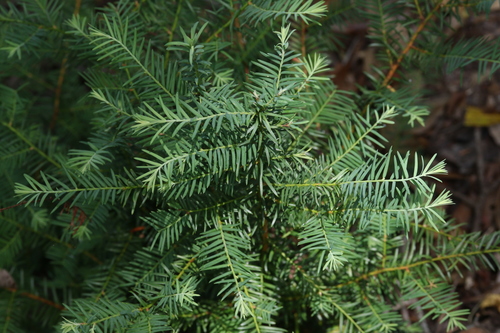
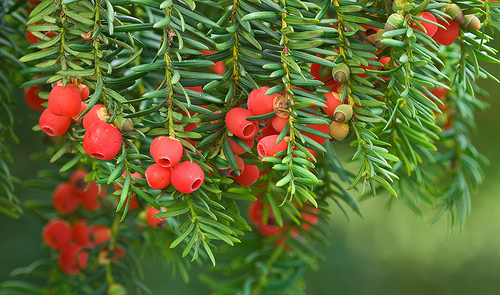
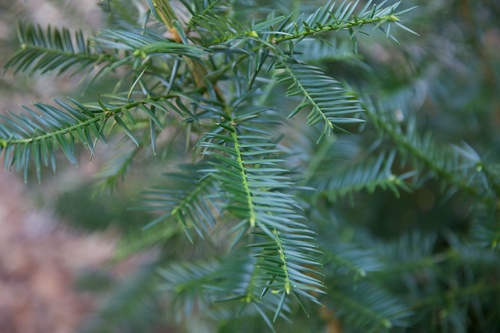
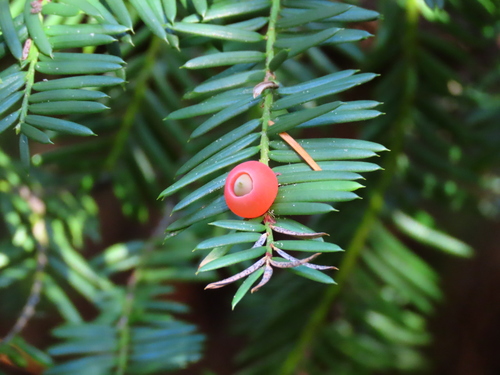
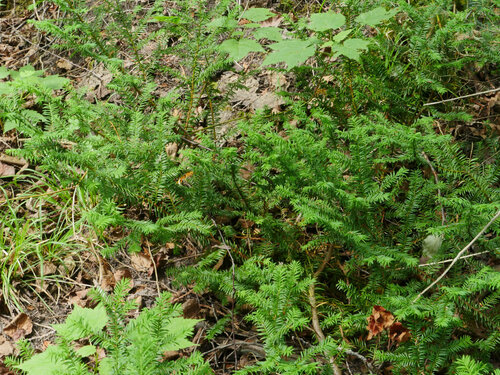
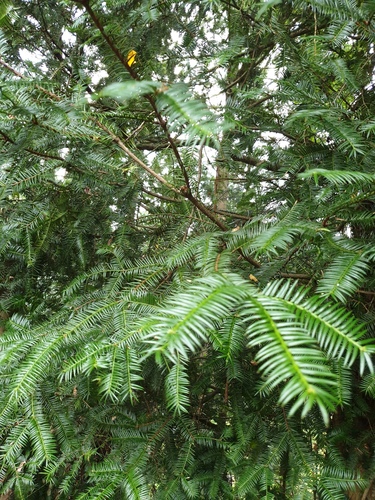
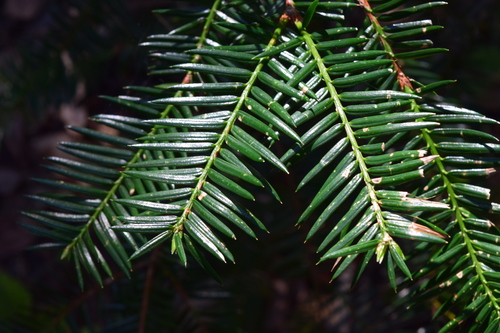
Torreya californica Torr., commonly known as California torreya, is an evergreen tree that typically reaches 15–27 metres (49–89 ft) in height, with a trunk diameter of 0.5–1 m (1+1⁄2–3+1⁄2 ft); exceptional individuals can reach a trunk diameter of 2 m. When growing in full sun, its overall crown is conical, with whorled branches. When growing in subcanopy shade, the tree may grow leaning and sometimes becomes multi-stemmed. This species has a taproot. Its bark is thin, measuring 0.8–1.3 cm thick on mature trees. Its leaves are stiff, sharp-pointed, needle-like, 3–8 cm (1–3 in) long, and persist for many years. Leaves are arranged spirally, but twisted at the base to lie flat on either side of the shoots. Like all species in the genus Torreya, male pollen cones are 5–7 mm long, grouped in lines along the underside of a shoot. Female seed cones grow singly or in groups of two to five near the end of a short stem, and require about 18 months to mature into a drupe-like structure that holds a single large nut-like seed 2.5–4 cm long. The seed is surrounded by a fleshy covering that turns dark green to purple when fully mature in late autumn. When growing on serpentine rock, California torreya becomes a stunted tree or shrub, and occurs only on north-facing slopes in coastal chaparral. It can resprout after disturbances such as fire, though regrowth is slow. The altitudinal range of T. californica extends from near sea level (though it usually grows above 200 m) in the Coast Ranges to 2,500 m (8,200 ft) in the Sierra Nevada. This shade-adapted subcanopy tree is native to mountainous habitats in California's Coast Ranges, or on the west slopes of the Cascade and Sierra Nevada mountain ranges that are distant from the coast. In the Coast Ranges, its distribution extends from southwest Trinity County south to Monterey County. In the interior mountain ranges, it is distributed from Shasta County south to Tulare County. Mountainous terrain allows this narrowly dispersed ancient conifer to track suitable microclimates by shifting altitude, local topography, slope aspect between cool northerly and warm southerly slopes, or between deep ravines and canyons, while staying on the same mountain. Short-distance range adjustments are crucial for this genus, because squirrels and humans are the most active agents of seed dispersal. The patchiness of its geographic range is a form of disjunct distribution. The species is considered rare, but it may be locally abundant wherever it occurs in the wild. This distribution pattern suggests it is a relict taxon that has struggled to navigate periods of climate change, where range shifts had to happen in topographically complex landscapes. A sister species in eastern North America, Florida torreya, was reduced to just a single population by climate change periods during the Quaternary glaciation. Its status as a glacial relict was recognized when it was listed as an endangered species. Range shifts have long been difficult for all species in the genus Torreya. Rodents are the only abundant and dependable seed dispersers, but they only gather and cache the large seeds over short distances. All Torreya species are adapted to establish and grow slowly as subcanopy woody plants in forest habitats with moderate to dense shade. In leaf structure and growth habit, they resemble species of yew, genus Taxus, which is a close relative. Torreya species are found in late seral and climax communities. Because they can resprout from the root crown after logging or mild fire, the species can access growth opportunities in the early stages of regrowing forest habitats. Upward growth is stimulated when a tree fall opens the forest canopy, or if nearby roadbuilding occurs. Stems lean in very shady conditions to reach patches of sunlight. Extremely leaning stems growing in a shady subcanopy accumulate moss as they age. An old leaning stem that cannot access sunlight will die, but before it perishes, the long-lived root crown will already have produced one or more younger stems that search for sunlight in different directions. Seed production occurs on female branches (and on entirely female trees) only when direct sunlight is available. Because the genus Torreya has very long-lived roots, it can maintain slow growth and replenish basal stems for many decades, without seed production being critical for the persistence of a local population. Commercial harvesting of California nutmeg is almost non-existent because the species is not widely available. In the past it was logged on a limited basis, especially when growing in association with coast redwood, but it was never an important timber species. Its fine-grained, yellow-brown wood is highly durable, strong and elastic, smooth in texture, polishes well, and emits a fragrance similar to sandalwood. The wood is sometimes used to make Go game boards, as a cheaper substitute for the prized kaya (Torreya nucifera) of Japan and Southeast Asia. The seeds were once listed in pharmacognostic literature under the Latin name nux moschata Californica. The seeds were reportedly a highly valued food for Indigenous peoples in California, though they are inedible when raw. Additionally, Indigenous Californians used its roots to make baskets and its wood to make bows.