About Torminalis glaberrima (Gand.) Sennikov & Kurtto
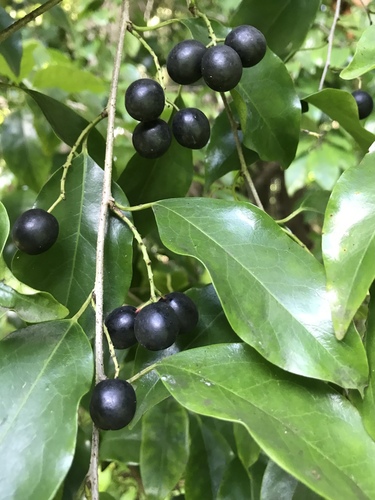
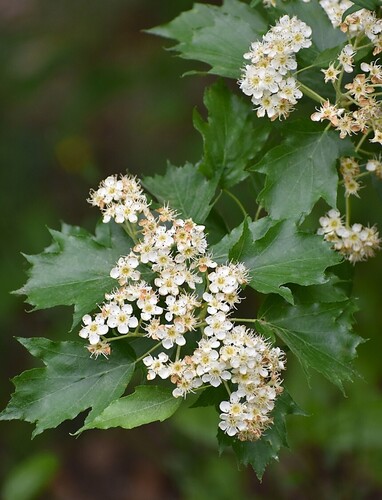
Torminalis glaberrima, the wild service tree, is a medium-sized deciduous tree that grows to around 30 m (100 ft) tall, with a trunk up to 1.3 m in diameter. Its bark is smooth and grey when young; once the tree reaches approximately 30 years of age, the bark becomes scaly, flakes away in squarish plates, and reveals darker brown layers underneath. Young twigs are lightly hairy, turn brownish, and quickly become hairless (glabrous). The tree’s pea-sized green buds, which have distinct brown-edged scales, make it easier to identify during winter. The leaves are 6–14 centimetres (2–6 inches) long and wide, borne on a 2.5–5 cm (1–2 in) petiole, and dark green on both surfaces. They have five to nine pointed lobes: the lowest pair of lobes spread outward, while the remaining lobes point more forward and decrease in size toward the leaf tip. Leaf margins are finely toothed. Young leaf undersides have small hairs, but both leaf surfaces become smooth and shiny as the leaf matures. Autumn leaf color ranges from yellow to red-brown. The flowers are 10–15 millimetres (3⁄8–5⁄8 in) across, with five white petals and 20 creamy-white stamens. They grow in corymbs 5–12 cm (2–4+1⁄2 in) in diameter, bloom from late spring to early summer, are hermaphroditic, and are pollinated by insects. The fruit is a globose to ovoid pome 10–15 mm in diameter, which ripens from mid to late autumn. Mature fruit is greenish to russet or brown, marked with small pale lenticel spots. This species occurs from Great Britain (England and Wales) east to Denmark and Poland, south to northwest Africa, and southeast to southwest Asia, ranging from Asia Minor to the Caucasus and Alborz mountains. The wild service tree prefers deep fertile soils, but can tolerate a wide range of soil conditions, from chalky, shallow, dry soils to temporarily waterlogged soils. It often grows alongside the true service tree. While it can adapt to various climatic conditions, it is most common in lowlands. It is a light-demanding species that is often outcompeted by other hardwood species. It is relatively rare; in Britain, it is now typically restricted to isolated areas of ancient woodland, though it may also be found growing in hedgerows. It often occurs in association with oak and ash woodlands. In Britain, summer temperatures are often too cool for its seeds to ripen, so its main method of reproduction is propagation via suckers. Its Ellenberg values in Britain are L=4, F=5, R=6, N=5 and S=0, meaning it grows in shady, moist woodland on neutral soils with moderate fertility, and has no tolerance for salt. The tree is ecologically important because its fruit is eaten by many bird species and a few mammal species. Many insect species are associated with the wild service tree. The goat moth, which has the second largest larvae in the UK, lays its eggs on the bark of the wild service tree. After hatching, the larvae burrow into the tree, feed on inner wood, and create large, visible tunnels that cause substantial harm and weaken the tree. Over time, these tunnels damage the tree’s structure, leaving it vulnerable to diseases, decay, and other infestations such as fungal infections or attacks from bark beetles like Scolytus mali. Severe damage can eventually kill the tree. Wood infested by goat moth larvae gives off a strong vinegar scent, and a substance described as "fermenting juice" collects at the base of the trunk. The phloem-feeding (phloeophagous) black beetle Scolytus mali damages trees by chewing through bark to reach the phloem. This beetle has a symbiotic relationship with a fungus in the genus Ophiostoma: beetles carry the fungal spores under the bark, and as the fungus grows inside the infected tree, it breaks down the tree’s tissues to make it easier for the beetles to feed on phloem. This genus of fungus is associated with tree diseases such as Dutch elm disease. Signs of a Scolytus mali infestation include many tiny entrance holes on the outer bark and gnarled tunnels under the bark. However, these insects are very small, and their entrance holes can be hard to spot, so an infestation is not always obvious. The wild service tree also hosts the mite Eriophyes torminalis Nalepa (1926), which feeds exclusively on the leaves of this species, making it monophagous. When the mite feeds, it injects saliva into the leaf surface, which causes the plant to grow abnormal tissue around the feeding site. This forms hollow galls that appear as brown blisters on both sides of the leaf, and the galls enclose the microscopic mites. The wild service tree produces one of Europe’s most valuable hardwoods. Its wood is fine-grained, very dense, and has good bending strength. Historically, it was used to make winepress screws, billiard cue sticks, musical instruments, and turnery items. Today, it is usually only used for decorative veneers. The fruit, sometimes called "chequers", is edible and tastes similar to dates, though it is now rarely collected for food. It is usually too astringent to eat until it is over-ripe and bletted. Traditionally, the fruit was used as a herbal remedy for colic. Before hops were introduced, the fruit was used to flavor beer.