About Torilis japonica (Houtt.) DC.
Height & Leaf Structure
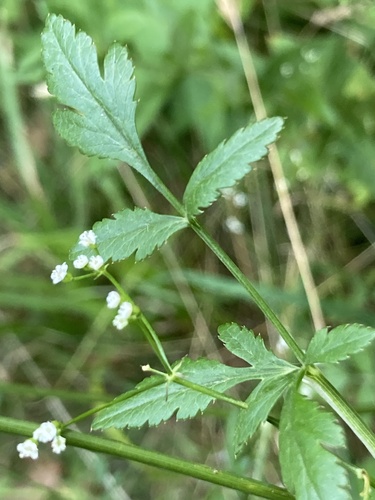
Japanese hedge parsley (Torilis japonica (Houtt.) DC.) typically reaches 2–4 feet tall in its second year of growth. Its leaves are fern-like, alternate, pinnately divided, and each leaf is supported by a very slender stem.
Flowering Period & Appearance
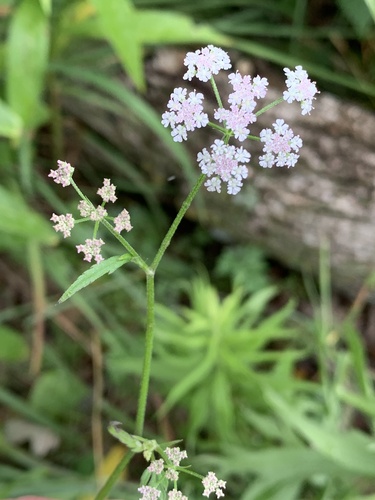
The plant does not flower until its second growth year, with flowering occurring from June to August. Its flowers are white with five petals, arranged in multiple broad, domed umbels.
Flower Sexual Structure
Central flowers are bisexual, while margins of the umbels have only staminate flowers. Each flower has five stamens that alternate with the petals, and the ovary is positioned below the petals.
Pollination Traits
This species is unspecialized, self-fertile, and very attractive to pollinators.
Fruit Texture & Color
Each plant produces bristle-textured fruits that are easy to disperse. Fruits are rosy, white, or green when young and turn brown when mature.
Fruit Type & Structure
The fruits are schizocarps that split into two mericarps when mature. These dry schizocarpic fruits stay closed until maturity and have two pollen-containing chambers.
Dispersal & Competitiveness
Each mericarp is five-ribbed, which makes the species' seed dispersal highly effective, and it competes strongly against native vegetation.
Native Distribution
Despite the species epithet 'japonica' meaning 'of Japan', the native range of Japanese hedge parsley extends from Western Europe to central Asia, northern Japan, and Mediterranean regions of northern Africa.
Regional Growth Classification
In Europe, T. japonica grows as a summer annual or biennial. In its invasive range in the United States, it is classified as a summer biennial. In Japan, it is classified as a winter annual.
Traditional Medicinal Uses
In traditional Chinese medicine, Japanese hedge parsley is known for its medicinal properties. It has been used to treat hemorrhoids, spasms, uterine tumors, fever, and dysentery.
Anti-Cancer Research Potential
Recent medical research indicates that Japanese hedge parsley may have potential as an anti-cancer treatment.
Torilin Compound Properties
A compound called torilin can be extracted from the plant, and it is a potent inhibitor of 5 alpha-reductase, the enzyme that converts testosterone to DHT. Torilin, which comes from the plant's fruits, has been shown to inhibit blood vessel growth during tumor development from the benign to malignant stage, so it has a toxic effect on tumors.
Torilin Research Applications
It has also been found to inhibit the conversion of testosterone to androgen, and this effect is being studied further for use in treating prostate cancer and alopecia.